The Odyssey
On the belligerent poetry of Christopher Nolan's The Odyssey

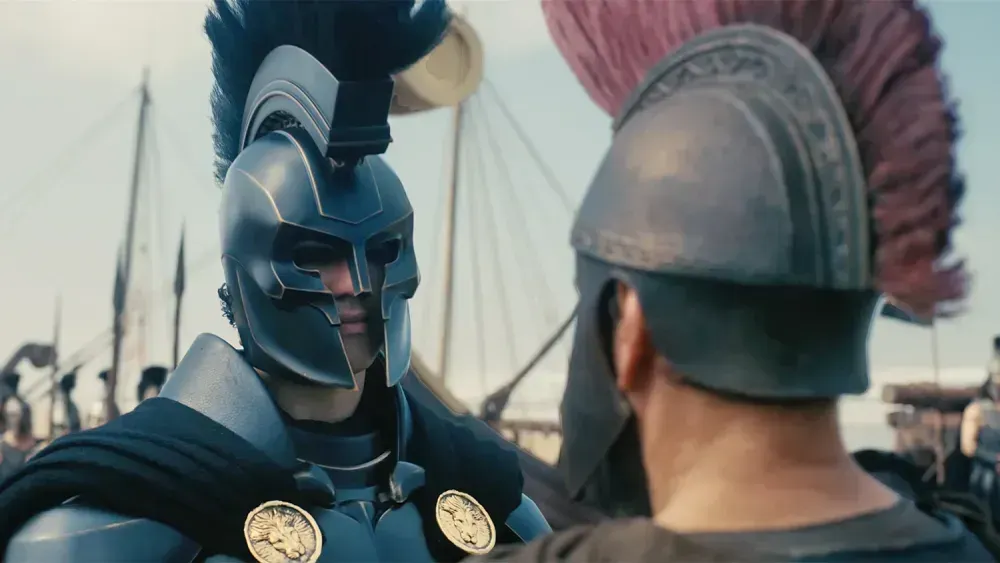
“All we know about the world is travellers’ tales.”
Christopher Nolan’s “The Odyssey,” the biggest film of the year so far, opens with Travis Scott as a bard spinning a yarn about one of literature’s most famous heroes, Odysseus (Matt Damon), and the Trojan Horse. Poets, bards and court singers play an integral role in the conceptual framework of “The Odyssey,” told as a series of stories told to others.
The King of Ithaca left his kingdom many years ago to lead as a general in the Trojan War. Twenty years later, he never returned home. His wife and queen Penelope (Anne Hathaway) reluctantly hosts suitors seeking to replace the long-lost king. His son Telemachus (Tom Holland), a young child when he left, grows into adulthood and enrages the dozens of suitors with his mere presence. The familiar story looks much the same: Odysseus’s long-winded homecoming involves a cyclops and a witch, giants and sea monsters, love and loss.
Nolan’s adaptation is both more coherent and didactic than the original. Odysseus’s actions in the war besiege him years later, and he is altogether less monstrous and more romantic than in Homer. This is not the dark anti-hero Ralph Fiennes depicted in Uberto Pasolini’s 2024 “The Return.” Damon’s shattered shell of a king only kills the number of suitors he must and leaves the rest to their shame.
The rapper in the role of the bard is the first of many modernizations. He paints stories using imagination to entertain an audience like an ancient songwriter or director. His words entertain and enrage, make fiction fact, morph villains into heroes, and even divinize mere mortals. And without these stories, the House of Odysseus and the Kingdom of Ithaca would be entirely alien. The pressure on Penelope to remarry would be insurmountable without a mythical husband, and Telemachus wouldn’t wrestle with masculine ideals if not for the ideal man he believes his father to be. Scott’s bard bangs a staff on the table rhythmically, giving his story of Odysseus’s heroism in the Trojan War a martial gravitas.
The musing on the role of the poet to society begins even before the film does with an opening title card that sets the context as “a time of apparent magic,” an adage just as much about the art of moving images as it is about Homer’s ancient Greece. Odysseus hunts a doe with a bow and arrow as he is introduced. He plucks his bow before loading his arrow to send a loud warning to the animal. The graceful note accompanying the pluck comes from a lyre, musically connecting art and violence for the first of many times.
Continue reading at The Rapidian.