Y Vân: The Lost Sounds of Saigon
The introduction to the music of Y Vân is reason enough to catch The Lost Sounds of Saigon.

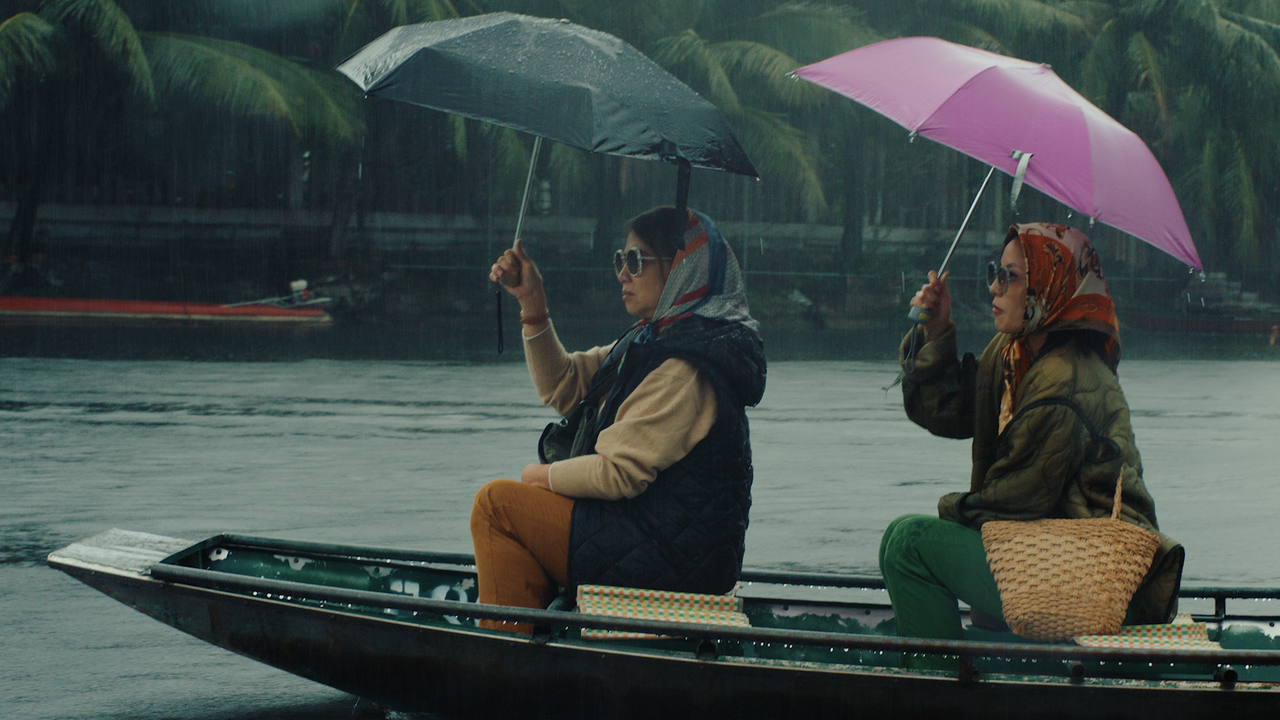
An opening narration from Vietnamese multidisciplinary artist and professional graphic designer Khoa Ha builds up a myth of a famous musician in pre-war Vietnam named Y Vân. “His songs became the soundtrack to an entire generation,” she trusts. He created hundreds of songs and his music was known throughout the country. The war, poor conditions of Vietnamese vinyls from the era, and the sheer speed of history turned his music and his life story into ghosts of the past. Y Vân: The Lost Sounds of Saigon is a quasi-spiritual documentary of his granddaughter, Khoa Ha’s vocative quest, to find, preserve, and share his lost music.
Y Vân, as we get to know him, is a genuinely interesting figure. His musical gifts were a curse that prevented him from pursuing a career in mathematics. He married, divorced, and remarried; lived through the Vietnam War; and became one of the most important songwriters of his time. His music as recovered and restored by Khoa constitute the entirety of the delightful soundtrack. His voice had a quiet and understated strength, his compositions jazzy with a pop-edge to them. One of his contemporaries describes his music as “calm” and, given the chaos of his context and the bustling streets of Saigon, his serenading appeal at the time is easy to understand. The introduction to his music is reason enough to catch Y Vân: The Lost Sounds of Saigon.
The visual presentation takes an unorthodox approach. The usual documentary interviews are interlaced with animated sequences that pull from Khoa’s graphic design background and abstract scenes of her wandering a desert and uncovering lost objects. The art design of the animation has a handspun quality to it that appropriately echoes the hard work of finding “lost” music.
As indicated in the animation, The Lost Sounds of Saigon is incredibly personal and there is no other way to tell this story truthfully. Khoa Ha and co-director Victor Velle open with a Thích Nhất Hạnh quote about seeing our ancestors in the lines of the palm of our hands, immediately demarcating the sentimentality of the film—a line that occasionally crosses over into kitsch territory. This isn’t a biography of an influential musician now lost to history. That would be another project for another day. This documentary is a shaking of the ancestral family tree to see what memories, dreams, and tears fall down.
Thematically, Khoa leverages the archival process—from the realization of what is lost, to the search, the material uncovering of the “lost” artifact, and, finally, its exhibition or presentation—becomes a metaphor for the preservation of culture and, more specifically, connection to an individual’s cultural identity. It’s vital that she finds his music not just because it is good and needs to be preserved, this is something she can’t even be sure of given the catalyzing predicament of an absolute detriment of both his vinyls and master recordings, but because the myth of his music is important to her own understanding of her family and thus her self. Now living in the United States, his voice connects her to Vietnam’s history. This archival work becomes tantamount to spiritual work. The abstract desert wanderings that mirror the ascetic practices of a monk and Nhất Hạnh’s opening quote support this framing.
Khoa narrates the film with a mixture of stream of consciousness and a more typical journalistic voice. Her platitudinizing—when she tries to follow in the sermonic footsteps of the influential Buddhist teacher Nhất Hạnh—pulls the attention away from her grandfather and his music and onto her. The corniest narration comes with B-roll of her overlooking a beautiful and foggy ledge as if the lead figure in Caspar David Friedrich’s Wanderer above the Sea of Fog. “At the height of Y Vân’s career, tragedy struck,” she summarizes, as if reading a teleprompter. Moments like this punctuate the documentary, even if they never overshadow the more earnest soul searching or the fascinating biographical subject of Y Vân.
Y Vân’s career was cut short by the Fall of Saigon or the Day of the Liberation of the South and National Reunification in 1975, depending on one’s political allegiances. The film comes out around the 50th anniversary of these events. The documentary makes assumptions in the small portion of its runtime it dedicates to the events of 1975, where the Western-aligned South Vietnam lost control of its capital, Saigon, to the communist forces of North Vietnam. Things were tough for everyone, food became expensive, and his songs were banned—one of them for using “Saigon” instead of the new name Ho Chi Minh City—but the actual politics of the war and its aftermath stay at arm’s distance. This is interesting given the way Y Vân and his contemporaries’ music is postured by a few of the talking heads in the documentary—ethnomusicologists, music historians, collectors, etc—as a bridge between the rock and pop of the West and traditional Vietnamese music. “We weren’t nearly as debauched as the Americans,” one fellow musician laughs,” while drawing sonic similarities. One can easily piece together more about why his music was seen as threatening, but this doesn’t seem to be a realm the documentary wants to pursue beyond scratching the surface.