Mother Mary
David Lowery doesn’t give easy answers, and that’s part of what makes the film special.

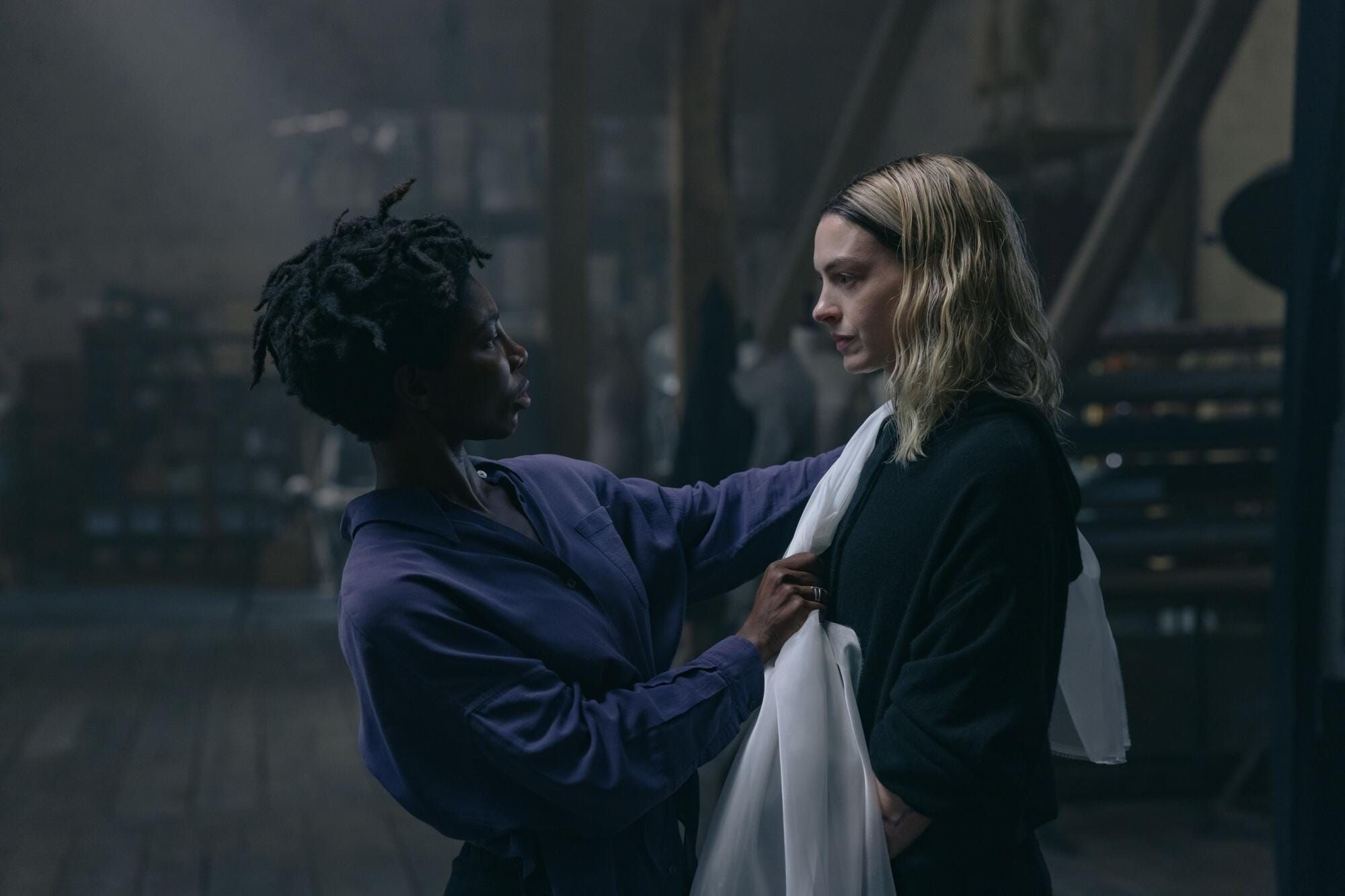
David Lowery’s “Mother Mary," a two-person chamber drama and gothic-supernatural thriller starring Anne Hathaway as a possessed pop singer, is the most thought-provoking film currently in theaters.
Something went terribly awry at Mother Mary’s last performance. That was some time ago, and the information is slowly, very slowly, drawn out. She frantically barges into the home-studio of successful costume designer Sam Anselm, played with tremendous gravitas by Michaela Coel of “Black Panther” fame, and begs her to make a new dress for her performance in three days. The two women clearly have a thorny past, and that also takes time to piece together. The majority of “Mother Mary” takes place at Sam’s isolated barn turned costume workshop as the two women talk discursively about their past, Mary’s mysterious accident, and the dress she needs.
As a largely one-room drama with only two leads, there isn’t a lot of wiggle room for the acting. And thankfully, Hathaway has never been better. She dons her character’s internal pain and trauma on her face, lusts with her eyes and convinces us she is a pop superstar with how she holds her body.
Sam asks her to dance the choreography to her new song “Spooky Action” to better understand the tone of the concert for the dress. Sam tells her to dance acapella. The mega pop star dances in sweatpants barefoot on the barn’s wooden floor without music. Her movements start typically modern with abstract moods and an intense physicality before the modern routine morphs into a beastly interpretative dance, as if Hathaway herself is possessed by a demonic creature. She violently brushes into her surroundings, pretends to collapse to the floor, and grunts and growls like a predatory animal. The direction takes advantage of the barn’s openness and lets more air resonate into the soundscape. Wood creaks too, as if her dance opened an unseemly door to a purgatorial world. The scene is so tremendous that Lowery couldn’t resist doing it twice. When the choreography returns, it is as the memory that inspired the dance and the routine loses its gaunt ambiguity by realizing the metaphor of possession too graphically. Sometimes, it’s usually better to let the artist interpret their inspiration than to show it.
Continue reading at The Rapidian.