“What Would You Say to the Sun?”: An Interview with Eeva Mägi on Mo Amor
Our conversation touches on peculiarities of the Estonian context, the essence of a Mo film, gender identity, and more.

This review is brought to you from my annual coverage of the Tallinn Black Nights Film Festival (PÖFF) in Estonia. Please consider supporting the only regular and recurring column on Baltic cinema in English.
The Estonian director Eeva Mägi has carved out a corner for herself as a steward of the strange in Baltic (loosely) narrative feature cinema. Her three Mo films—Mo Mama, Mo Papa, and this year’s Mo Amor—all deal with incredibly personal and dangerously domestic topics around love, grief, and parental love while preferring surreal and fable-like emotionally coherent stories rather than plot-structured ones. They feel improvised, raw, and employ a variety of means—such as still frames and unconventional camera angles—that pull her films away from the land of traditional verisimilar filmmaking. This is only natural given her approach to hierarchy-free sets and scriptless directing, something she has referred to elsewhere as a “Mo-movement,” a serious and simultaneously jestful claim to a film movement not unlike the Danish Dogme 95.
Eeva Mägi is the cold queen of the weird and ineffable. Think: Yorgos Lanthimos but sentimental, Northern European, and fable-laden. Three films in, Mo Amor shows us her weirdness is going nowhere; and thank the gods of cinema for that.
I was at the world premiere of Mägi’s debut feature, Mo Mama, at the 27th Tallinn Black Nights Film Festival. It was one of those films that had a forceful vitality regardless of one’s personal evaluation: Mägi’s potential, in other words, was obvious, even if one didn’t love the film. My review for Offscreen opened with the following:
Eeva Mägi is a promising young Estonian director with a gift for creating compelling nostalgic visuals and her first film, Mo Mama, had its world premiere in Tallinn on November 9th. The Eastern European film world and globetrotting cinephiles will be better off for it too.
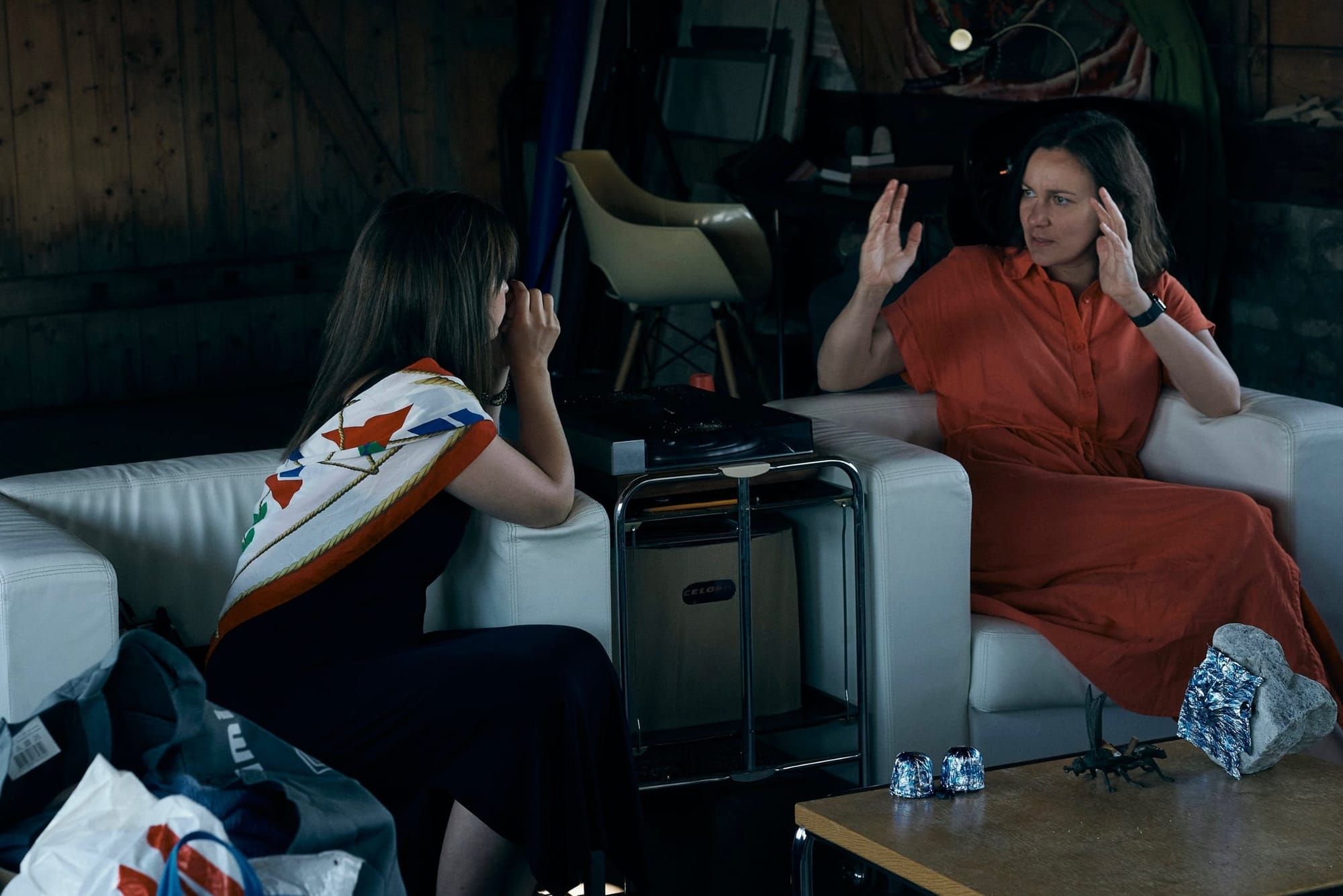
Mo Amor premiered at PÖFF30 in the Critics' Picks Competition. It’s a more defined and stylistically confident film than her debut. Photographer Kaur (Jarmo Reha) tells a modern fairytale about Princess Niina (Ester Kuntu), a woman at a mental and emotional crossroads in life with three eager male suitors: The Writer, The Mentor, and The Stonemason. She doesn’t know what (or whom) she wants from life. She is lost between the three suitors—and lost in herself. This is because Niina is an identity that Kaur no longer identifies with. Kaur, as a masculine narrator, tells us, invites the three suitors to an idyllic and isolated summer home on the Estonian island of Vilsandi, and there courageously decides to be true to himself.
I’ve been reflecting on Mägi’s brief but promising career in the time since she agreed to be interviewed and formulating my questions for the interview. In that time, I couldn’t stop smiling: I felt vindicated. In her debut—a film I didn’t love—I pointed to her potential to make a great film. I saw Mo Amor and realized I was right back in 2023 and this film proved that correct. Mägi has cultivated a specific taste, and it’s audacious, distinctive, and even addicting.
Our conversation touches on peculiarities of the Estonian context, the essence of a Mo film, gender identity, and more.
Read my full review of the Mo Amor here.
Joshua Polanski: What should non-Estonian readers know about Vilsandi?
Eeva Mägi: Vilsandi is one of the westernmost islands of Estonia, with extraordinarily beautiful landscapes, unique nature, and incredible light. I like to think of it as our own Bergman Island. I never get tired of making films there. The landscape, the changing seasons, the sea, and especially the light have so much to offer. Every time I return, I discover something new. It's a place that constantly inspires me.
JP: Where does the “Mo” in the titles come from?
EM: I was born on Saaremaa, an island in western Estonia, where we speak a particular dialect of Estonian. In the Saaremaa dialect, “mo” means “my” or “mine.”
JP: What was the original impulse behind Mo Amor?
EM: The original impulse behind Mo Amor was a simple question: “Can love survive the truth?” I was interested in exploring what happens when the person we love reveals something that challenges our understanding of who they are. Is our love attached to the image we have created of someone, or can we truly love another person for who they are?
JP: Do you know if this is the first Estonian feature film with a trans man protagonist?
EM: I can't say for certain that Mo Amor is the first Estonian feature film with a trans man as its protagonist, but I'm not aware of any previous examples.
JP: The actors playing Niina and Kaur are both cis gender. From my understanding, this was because there were no trans actors available in Estonia for the parts. You also did research and consulted with people in the trans and queer community. What did you learn from talking to people closer to Niina/Kaur in these ways than yourself?
EM: Yes, that's true. We couldn't find a trans actor for the role, and I discussed our casting approach with people from the trans community. The people I spoke with were supportive of our decision to have Ester Kuntu play Niina and Jarmo Reha play Kaur. But perhaps the most important thing I took away from these conversations was how tired people were of seeing transgender characters portrayed almost exclusively through their struggles, suffering, or transition. There was a desire for stories in which trans gender people could simply live their lives, experience happiness, fall in love, make mistakes, and be just as complicated and imperfect as anyone else. That was very important to me. I wanted to make a film in which a transgender man could freely experience love, happiness, jealousy, desire, and all the contradictions that come with being human. Because although love is always deeply personal, it is also profoundly universal. I didn't want to make a film about the suffering of being transgender. I wanted to make a film about love.
JP: For those transitioning, there is a certain power in naming. Choosing a name that better suits one’s gender identity is an act of self-love and a reclamation of self. With this in mind, how did you come to the name Kaur?
EM: To be honest, I simply felt that his name was Kaur. I never even considered another name. Sometimes, when creating a character, certain things arrive with such clarity that you don't feel the need to question them. And if the feeling was that certain, then Kaur it had to be.

JP: The three suitors are characterized by their vocations: The Writer, The Mentor, and The Stonemason. The Stonemason particularly feels unique. How did you arrive at these three?
EM: Since Kaur is a photographer, we wanted his profession to be reflected in the world of the film and in the people surrounding him. For a young photographer, a mentor can be an important figure, someone who helps shape not only your artistic vision but also your understanding of yourself. The three suitors are all connected to different aspects of Kaur's personality and to what he is searching for in other people. Each of them represents a different possibility of connection, friendship, or love.
JP: How did you define the visual look of the film?
EM: Together with my cinematographer Sten-Johan Lill and production designers Ulvi Tiit and Allan Appelberg, we talked a lot about Kaur's inner journey and emotional world. We wanted the visual language to reflect what he was experiencing internally, creating a contrast between his nightmares and the beautiful world surrounding him. For me, the visual style of a film should always grow out of the character's emotional experience. Rather than deciding beforehand how a film should look, we try to discover the visual language that best expresses what the character is feeling.
JP: What makes a Mo film to you? What is the heart of the “series”?
EM: For me, the heart of the Mo films is artistic freedom. They give me the possibility to express myself freely, to experiment, to follow my intuition, and to discover things I could never have planned in advance. I want to make films that remain close to what I believe is the very heart of cinema: the ability to capture life, emotions, and those unexpected moments of truth that cannot always be written or controlled.
JP: What can you say about the next Mo film?
EM: My next film, Mo Hunt, is a staged documentary that explores the boundaries between artistic freedom and exploitation. It asks how far we can go in the name of art, and how much we can demand from other artists before artistic collaboration turns into an abuse of power.
JP: Will you ever direct a film without Mo in the title?
EM: Of course! But even if Mo isn't in the title, I'll make sure that if a film is directed by me, it will always be a Mo film.
JP: Your film is more a film of questions than answers. Here, I’m making you answer questions. To end, I’d like to ask you to ask a question of viewers. What would you like to pose to viewers/readers?
EM: When I'm on Vilsandi, I watch the sun set almost every evening, and I often find myself talking to it. But one evening, I realized that I had run out of words. I simply didn't know what else to say to the sun. So perhaps that's the question I'd like to leave with the audience: What would you say to the sun as it sets, again and again?