Fritz on Fridays: Destiny
My best friend recently told me about the Benadryl Hat Man.

On the first Friday of every month, this column by critic Joshua Polanski will feature a short review or essay on a film directed by Fritz Lang (1890-1976), the great Austrian “Master of Darkness.” Occasionally (but not too occasionally), Fritz on Fridays will also feature interviews and conversations with relevant critics, scholars and filmmakers about Lang’s influence and filmography.
My best friend recently told me about the Benadryl Hat Man. More people than you’d expect taking the allergy drug report dreams of a tall, faceless man lurking in the shadows and wearing a recognizable trilby or top hat. Most illustrations depict him in a suit although they are too obscured by shadow to fully tell. Several influencer reels joke, expectedly, about a sexual angle to the shared hallucination. A tall and well-dressed man visits in your sleep. My friend, though, tells me there is something unseemly about him in her dreams. She avoids him.
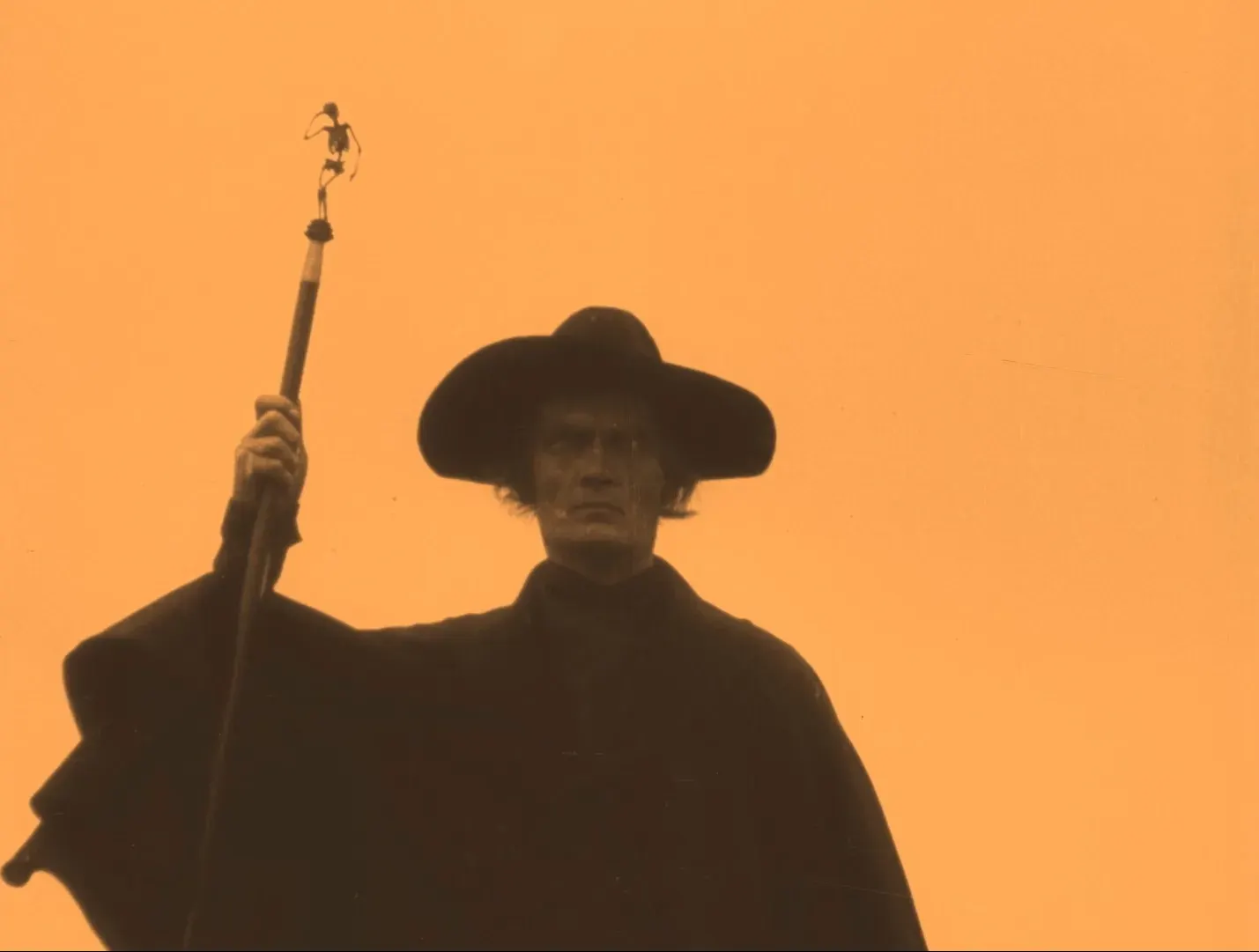
I thought about the Benadryl Hat Man while rewatching Fritz Lang’s 1921 fantasy film, Destiny. The ghastly figure of Death (Bernhard Goetzke) transpires onto the screen like a spectre. Though we see Goetzke’s face, there is something mysterious about him, as if we weren’t meant to see him. He too is tall, wears a hat and is well-dressed. He hitchhikes a carriage ride alongside a newly married couple, played by Lil Dagover (Lang’s first muse) and Walter Janssen (both of whom continued to act in films in Nazi Germany, for those counting their fascists). Death buys property in town and takes the husband of “the loving couple” the way Death does. The wife begs for her lover back, and Death gives her three chances to do so by transporting her to three different times and places — Ramadan in an early medieval Muslim society, the Carnival festival in Renaissance Venice, and seemingly ancient China — to save doomed men with love.
Like the Hat Man, there is something strangely sexual about Destiny. The entire narrative hinges on a verse from Song of Solomon, famously the Bible’s most sexual book. Enjoying the company of strangers and alcohol in a local inn, the wife briefly leaves and gets distracted in another room. There is another woman and a cat in this room. When she returns to the room where her husband was, he isn’t there. He has left with the stranger, another man tells her. There is something quite queer about the facts of the plot on a literal level: A young man, just married, abandons his female spouse to leave with an older man as soon as alcohol touches his system. The tall, stoking allure of the well-dressed figure doesn’t help. He confidently talks with his eyes more than his mouth and that, too, has sultry undertones. The age dynamic between the two — as well as certain character design elements in the Muslim story — points to stereotypical understandings of gay relationships at the time. He is like a predator pouncing on the man as he would prey. Modern eyes may even take note of the establishment’s name where Death abducts the man: the Golden Unicorn Inn.
Continue reading at the Midwest Film Journal.