Born in the Jungle
The film’s beautiful animation truly romances with style. It’s just a shame it’s all in service of romanticizing the colonialist European exploration of the Americas.

Latvian cinema, and especially animation, has been under either a spotlight or a microscope, depending on the vantage point, since Flow took home the country’s first-ever Academy Award. The 2025 French industry event Cartoon Movie spotlighted the Baltic country’s animation, and the country has even further capitalized on the film’s success with promised investments for animation. Latvian was also the focus country for Lisbon’s MONSTRA Animation Film Festival 2026. It’s in this pressurized context that Latvian animated feature director Edmunds Jansons’ new film, Born in the Jungle, blunders its chance to follow the successful path of Riga’s dark grey cat.
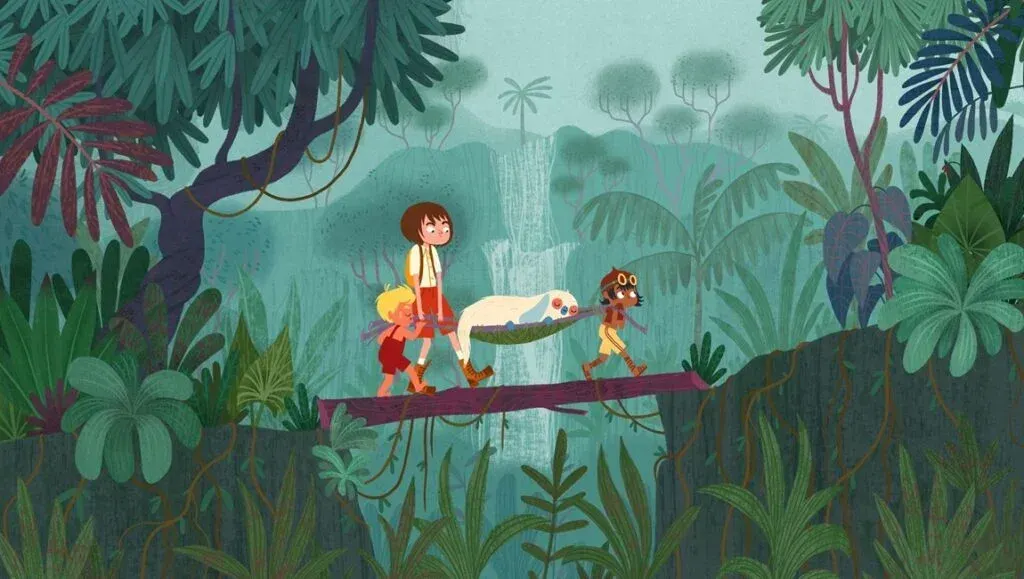
The concept is essentially Home Alone but in a jungle. In 1950s Venezuela, Elizabeth’s parents decide to spend the summer in the middle of the jungle, far from their social lives in Caracas. Elizabeth, at just nine years old, already knows the jungle isn’t for her. Her yet-to-talk younger brother Leo has a different story. The chaotic jungle is just a green playground to him. When mom and dad head to the city for a day, they leave an unprepared Elizabeth in charge. Alligators, leopards, sloths, monkeys, and more greet the siblings in their day-long adventure into the jungle near Angel Falls. The two make friends with a mythical otter-hamster creature they name Fluffy, a little Indigenous kid named Nev, and wind up in a game of cat-and-mouse with poachers who want the creature for their own grubby financial gain.
Keen viewers may note that Jansons’ colorful and friendly animation finds its closest Western comparison in Rugrats, and that’s not by accident. Rugrats creators Igor Kovalyov and Klasky Csupo, Russian and Hungarian filmmakers respectively, were tremendously influenced by the work of Estonian auteur animator Priit Pärn (Triangle, Night of the Carrots) and his graphical surrealism. Jansons was an actual student of Priit Pärn at the Estonian Academy of Art, where he earned an M.A. in animation. Keeping the creative colorist and unpolished homey appeal, Jansons’ films don’t simply regurgitate the master’s: the former is less serious and always beautiful, the latter is more moralistic and occasionally willing to let his films get ugly.
Continue reading at In Review Online.