La Bola Negra
Sebastián outlived the war, but he didn’t survive fascism. Nobody does.

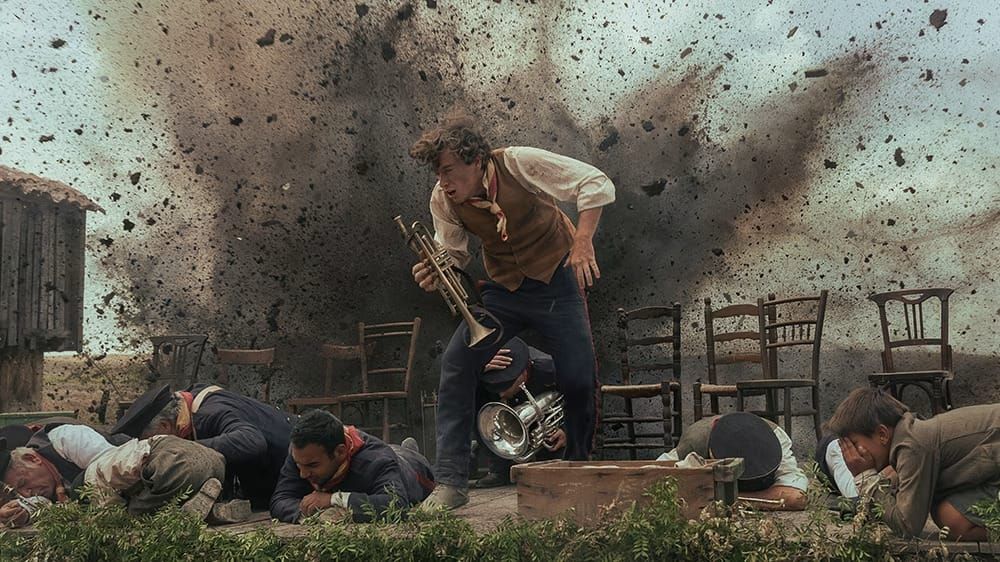
When the Italians “mistakenly” bomb his pastoral village, a still romantic bohemian fascist in the Spanish Civil War climbs through the rubble of his imploded church, trumpet in hand, fleeing the ensuing gunfire. A white marble statue of an arrow-pierced Saint Sebastian, dirtied by the ashes of bombs, lies crumbled on top of the altar. His hands grip the arrows penetrating the martyr’s body as the camera graces its masculine musculature. The nationalist climbing the ecclesial rubble is also named Sebastián (Guitarricadelafuente). And fascism will also destroy him.
This is “La Bola Negra,” the Spanish-language Netflix release from co-directing team Javier Calvo and Javier Ambrossi. The queer epic is massive in ambitions that only feel right to call dreams. The title translates to “The Black Ball” and is based on an unfinished story by Federico García Lorca, a gay Spanish poet killed by Franco’s nationalist forces in 1936. There are only four pages, but they leave no doubt of the play’s only queer beating heart: a young man, Carlos (Milo Quifes), applies to join a prestigious casino in Granada and is rejected because of his queer sexual orientation. Suited members vote with white (yes) and black (no) balls.
The film has both an ironically liberating and incredibly restrictive task of adaptation before it. On one hand, the length and inconclusive source material open up the possibility for creative wanderings typically unwelcome in adaptations; on the other, to capture an essence of such a short work becomes more and more elusive the shorter the source. And yet, the 2 hours and 37 minutes rebuild Lorca’s meek four pages into a cathedral of gay cinema. It is a work of reclamation in a strange way, a practice essential to queer modernity.
“La Bola Negra” starts in three timelines: 1932, 1937 and 2017. Each story seems independent, but the timelines eventually collide. The earliest is the actual, diegetic adaptation of “La Bola Negra.” In 1937, during the war, Sebastián flees his village, and the fascists put a gun in his hands. He guards, from the hospital bed, a wounded prisoner of war, a theater troupe member and footballer turned republican, Rafael Rodríguez Rapún (Miguel Bernardeau). Sebastián is instructed to make conversation with Rafael and extract any important information from him, if possible. In 2017, the same year as the Catalan independence referendum and constitutional crisis, a budding historian, Alberto López Azcuna (Carlos González), mysteriously inherits documents left to him by his grandfather, whom he never met.
Continue reading at The Rapidian.