How to Divorce During the War
Life moves on even when innocent eyes are met by the angel of history’s glare.

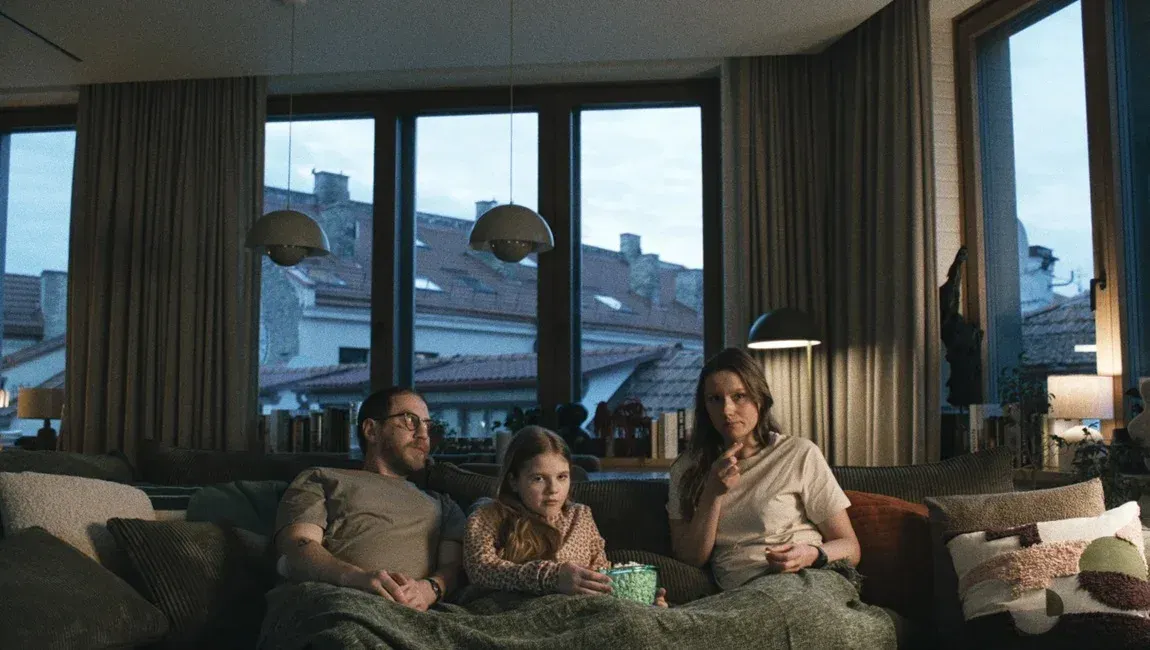
“As Rotterdam burns, they study Sanskrit verb forms,” is how one iteration of the famous proverb goes. This version of the maxim targets scholars with their vitriolic blind eye to injustice. How to Divorce During the War, the year’s biggest Lithuanian film and Sundance award-winning drama, is a poetic response to this famous proverb — not in the sense that parsing verbs will put out the fire, but in that something as quotidian as grammar might occupy our attention in a time of war. Life moves on even when innocent eyes are met by the angel of history’s glare.
In How to Divorce During the War, life includes the titular separation, which begins when Marija (Žygimantė Elena Jakštaitė) tells her husband Vytas (Marius Repšys) that she no longer loves him. She lies about there not being anyone else, even though her sapphic paramour is more of a pressure valve release than marriage-breaking catalyst anyway. The next day, Russia invades Ukraine. But before that, something important happens in the car where Marija tells Vytas she doesn’t love him anymore while waiting for their daughter’s violin practice to finish. Crying, she confesses their relationship and the person it makes her “suffocates” her. As quickly as the codeword that triggers the Winter Soldier in the Captain America films, Vytas grabs her throat with two hands. She resists, and then he leaves the car, gets back in, and they air out more relationship issues. Marija calls him a little of this and a little of that, and neither of them address the abuse. Not in the car, not later. The closest the film comes to revisiting his abusive tendencies is in depicting his new hobby of breaking Russian car windows, but there is of course a fundamental ethical distinction between property damage and domestic abuse. The brief scene doesn’t ruin the film — and there is a fair metaphorical reading therein given Marija’s use of “suffocating” and a later scene where their daughter chokes on food — but it nonetheless builds a rather tall wall for audiences to overcome to try to empathize or side with this man in any way, which the film seems to want from its audience.
During this eventful talk, director Andrius Blaževičius positions Marija on the right and Vytas on the left of the car, with the camera centered on the windshield, and the negative space between them is tense enough to become noxious. After her practice, their daugher Dovilė (Amelija Adomaitytė) sits in the backseat, choosing the middle seat instead of either window option, putting her squarely between the faces of both parents for the ride home, the center in a game of tug-of-war.
Continue reading at In Review Online.