Fritz on Fridays: Die Nibelungen: Kriemhild’s Revenge
An essential film in the filmography of cinema’s Odysseus

On the first Friday of every month, this column by critic Joshua Polanski will feature a short review or essay on a film directed by Fritz Lang (1890-1976), the great Austrian “Master of Darkness.” Occasionally (but not too occasionally), Fritz on Fridays will also feature interviews and conversations with relevant critics, scholars and filmmakers about Lang’s influence and filmography.
The global box office has been locked in an era of franchise slop and algorithmically produced IP for the better part of a quarter-century. Sequels and prequels have been the name of the game for as long as I’ve been on this planet. As the usual narrative goes, this was something new to the New Hollywood ushered in by George Lucas and Steven Spielberg. The truth, of course, is that IP has been a loyal partner to cinema since the days of the Lumière actualités. But it was Fritz Lang, the Austrian beating heart of the pre-war German film industry, who gifted cinema the original masterpiece sequel.
Die Nibelungen: Kriemhild’s Revenge is a sequel to one of the greatest movies ever made. It is one of the greatest sequels ever made. And, depending on the day of the week, it might, too, be one of the greatest movies. The least that can be said of it is that Kriemhild’s Revenge is an essential film in the filmography of cinema’s Odysseus, one of the greatest to ever do it and an architect of the form.
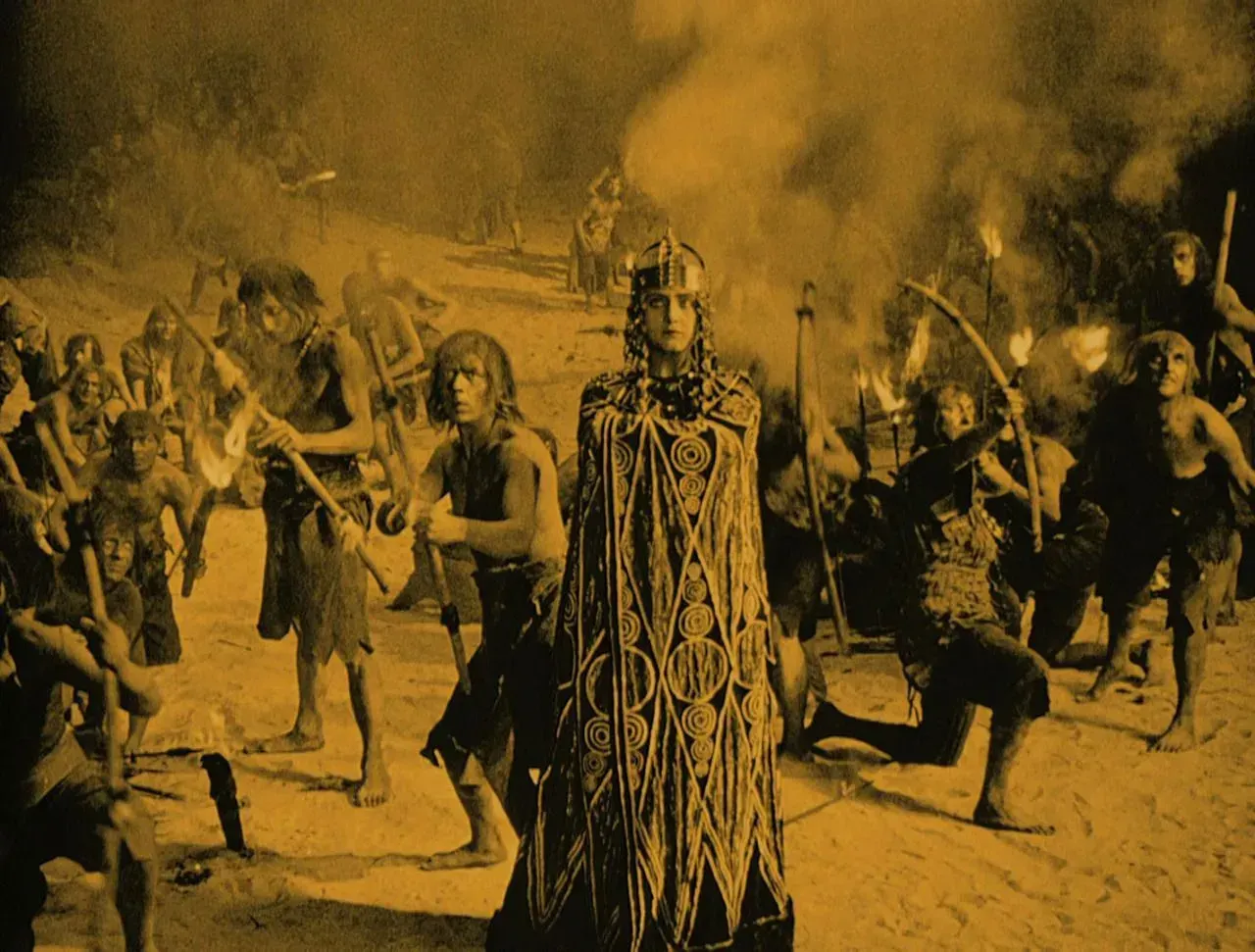
The second part of Lang’s adaptation of the epic Nibelungenlied poem picks up right where Die Nibelungen: Siegfried left off: Kriemhild (Margarete Schön) swearing revenge on Hagen (Hans Adalbert Schlettow), the advisor to King Gunther (Theodor Loos, future president of the Reichsfilmkammer), for the killing of her husband, Siegfried. In a medieval patriarchal society, Kriemhild leverages her treasured femininity to solicit the aid of King Etzel (Rudolf Klein-Rogge), better known to history as Attila the Hun, and his army to carry out her bloody task.
The costumes are impeccable. Regal patterns, especially making use of the courtly triangle and heavy metal, psychologize before the dialogue and become a character map to something akin to attire-phrenology. The plain, almost nun-like shrouds of Kriemhild stand out in this world of excess: Only her proud queenly crown stands apart. Costume designer Paul Gerd Guderian died during production of tuberculosis and his designs were realized by Aenne Wilkomm. He was just 27 years old, more than a full year younger than me as I write this review.
Continue reading at the Midwest Film Journal.