Fritz on Fridays: Cloak and Dagger
We still need this warning. Fearfully so.

On the first Friday of every month, this column by critic Joshua Polanski will feature a short review or essay on a film directed by Fritz Lang (1890-1976), the great Austrian “Master of Darkness.” Occasionally (but not too occasionally), Fritz on Fridays will also feature interviews and conversations with relevant critics, scholars and filmmakers about Lang’s influence and filmography.
Fritz Lang didn’t like the Nazis. He was, by many accounts, a disagreeable man. But on this, hopefully, we can all agree. It also might be an appropriate time to revisit Lang’s anti-fascist films, including the underrated Cloak and Dagger, a spy film about nuclear secrets and the Italian resistance.
Lang fled Europe in the mid-1930s and it wouldn’t take too long before he helmed a series of anti-fascist spy films. He would make four anti-Nazi genre films (following Man Hunt, Hangmen Also Die! and Ministry of Fear) in a short five years beginning in 1941 and ending in 1946. His brief fascist obsession simmering with the war might reveal his own propagandistic intentions; his later war film, American Guerrilla in the Philippines, is much more of a standard war picture than it is an indictment of political systems, for example. Cloak and Dagger, the final of the four films, like many of the director’s best films, keeps systems of power in its crosshairs rather than powerful people.
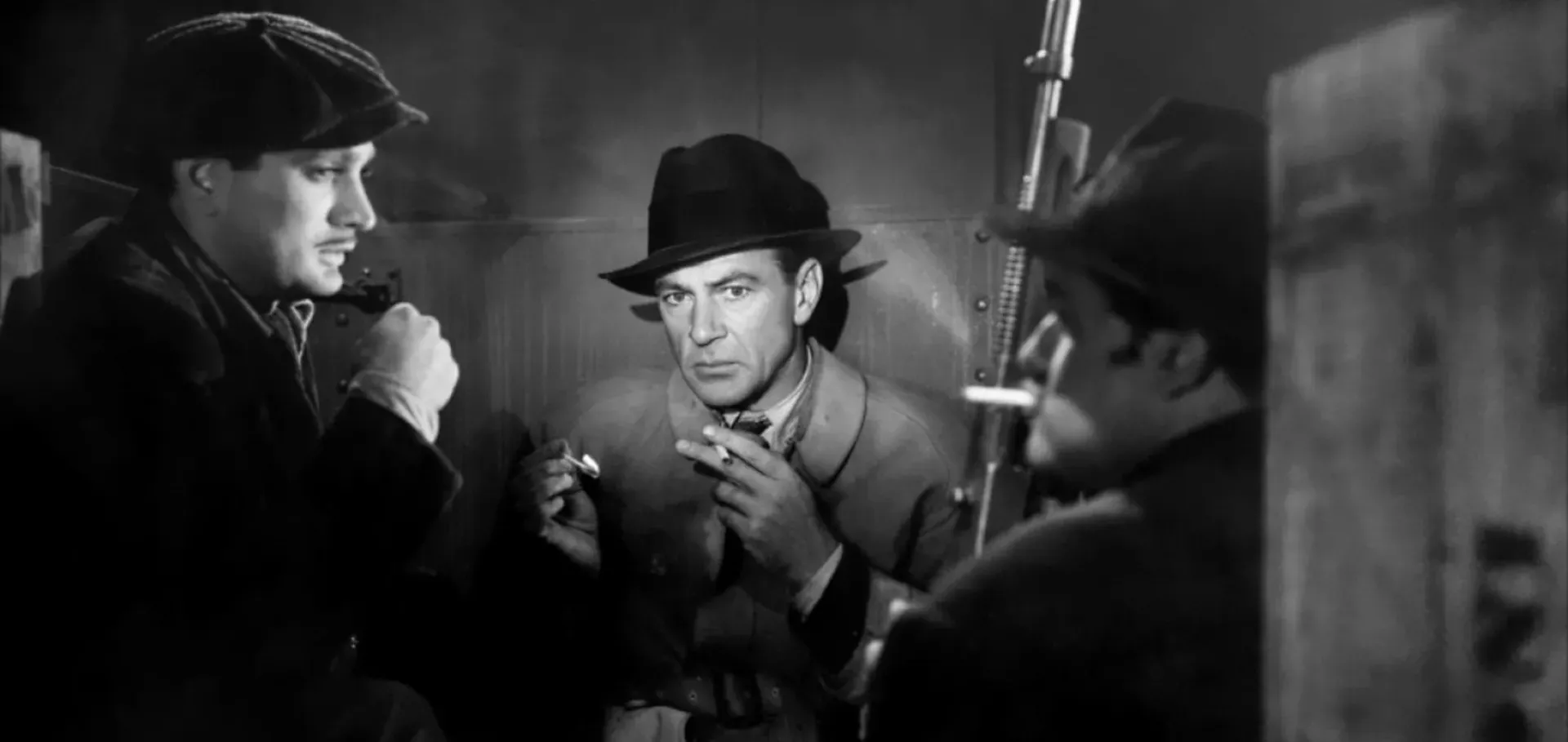
In his introduction in Cloak and Dagger, professor Alvah Jesper (played with a typical wisdom and horniness by Gary Cooper in an obviously Oppenheimer-inspired role) poetically laments the danger of human domination in his “I’m sorry I’m a scientist” speech — not-so-ironically filmed just several months after the monstrous nuclear attacks on Hiroshima and Nagasaki. Jesper’s speech is one of Lang’s rare moments of earnest political clarity. Lang, via Jesper, shows deep reflection not just of fascism but also the war-mongering American empire built to confront it.
Jesper is working on the Manhattan Project when he is recruited by an old friend in the CIA-precursor Office of Strategic Services (OSS) to establish contact with Katerin Lodor (Helene Thimig), a Hungarian physicist he knows and who, until she escaped to Switzerland, was working with the Nazis to develop an atomic bomb. (This was one of the first films permitted to mention the OSS.) Jesper accepts the role but not without acknowledging the bomb is an evil, an unnecessary one at that; and yet, it’s a great moral conundrum that the Allied forces must also get the weaponry before the Axis:
“Society isn’t ready for atomic energy … I’m scared stiff. For the first time, thousands of allied scientists are working together. And for what? A bomb? Who was willing to finance scientists before the war, to wipe out tuberculosis? And when are we going to be given a billion dollars to wipe out cancer? I tell you, we could do it in one year.”
Jesper’s caution is fearful of the violence of war and also cognizant of the larger inner workings of the failed state that employs him. He points directly to the potential of a fission bomb to “pulverize this university, this whole town, its fine hospitals, its libraries, its wonderful medical schools, to say nothing of all the people in it.” The disparity between the funding of science to end lives rather than to save them isn’t an accident. The gap in the one enables the excess in the other. Our scientist also acknowledges those weapons one day may turn. He even opens his speech imagining atomic energy vaporizing the university he stands on rather than some foreign land. When Jesper chooses to help the OSS, he does so only as a commitment to a lesser evil.
Continue reading at the Midwest Film Journal.