“The Blind Witness to Our End”: Ruminations on James Cameron’s Avatar: Fire and Ash
To feel important is to feel loved.

This is a spoiler-overflowing essay on Avatar: Fire and Ash. For a more general, spoiler-free review, read my earlier post here.
The tulkun instantly became one of the most controversial creations of James Cameron’s storied Hollywood career when introduced in Avatar: The Way of Water. The talking and singing cetaceans were at the center of many critical and popular criticisms, some sillier than others. He devotes less time to hanging out with the whales in Avatar: Fire and Ash, but they are no less important. There is also a new tulkun, Ta’nok, who might be the key to the incredible third film.
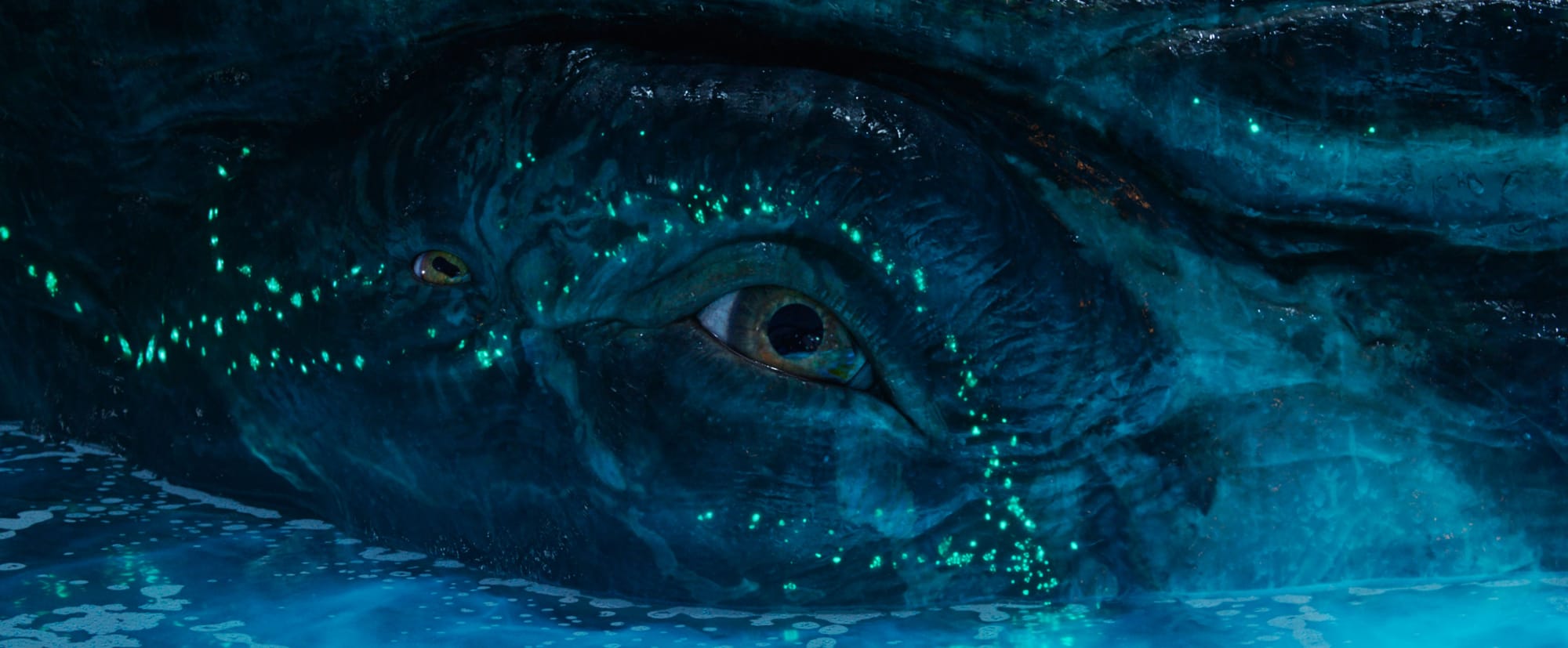
Ta’nok comes from the same clan as Payakan, the brother tulkun of Lo’ak (Britain Dalton), the film’s narrator. Payakan seeks his birth clan after being banished from the seas near the Metkayina for violating the pacifist philosophy of the tulkun. He hopes to protect his kin; instead, he must mourn them. The sky people slaughtered his entire birth clan. Only the scarred skin and shrapnel-laced Ta’nok survived. She, like Payakan, discarded their ancestral pacifism and decided to fight back. Harpoons reach from her skin like grass in a field and the cost for her life was her sight: empty caverns lie where her eyes should be. Treading water before the quasi-religious council of tulkun—a council hearing the Toruk Makto (Sam Worthington) and Tonowari (Cliff Curtis), leader of the Metkayina—Ta’nok tells her story, shows her scars, and names herself “the blind witness to our end.”
It is the truths witnessed by the blind tulkun that ultimately give the matriarch and her council the reason and the chutzpah to overturn the ancient path of pacifism for a just war. A blind witness helped correct their sight for the new times.
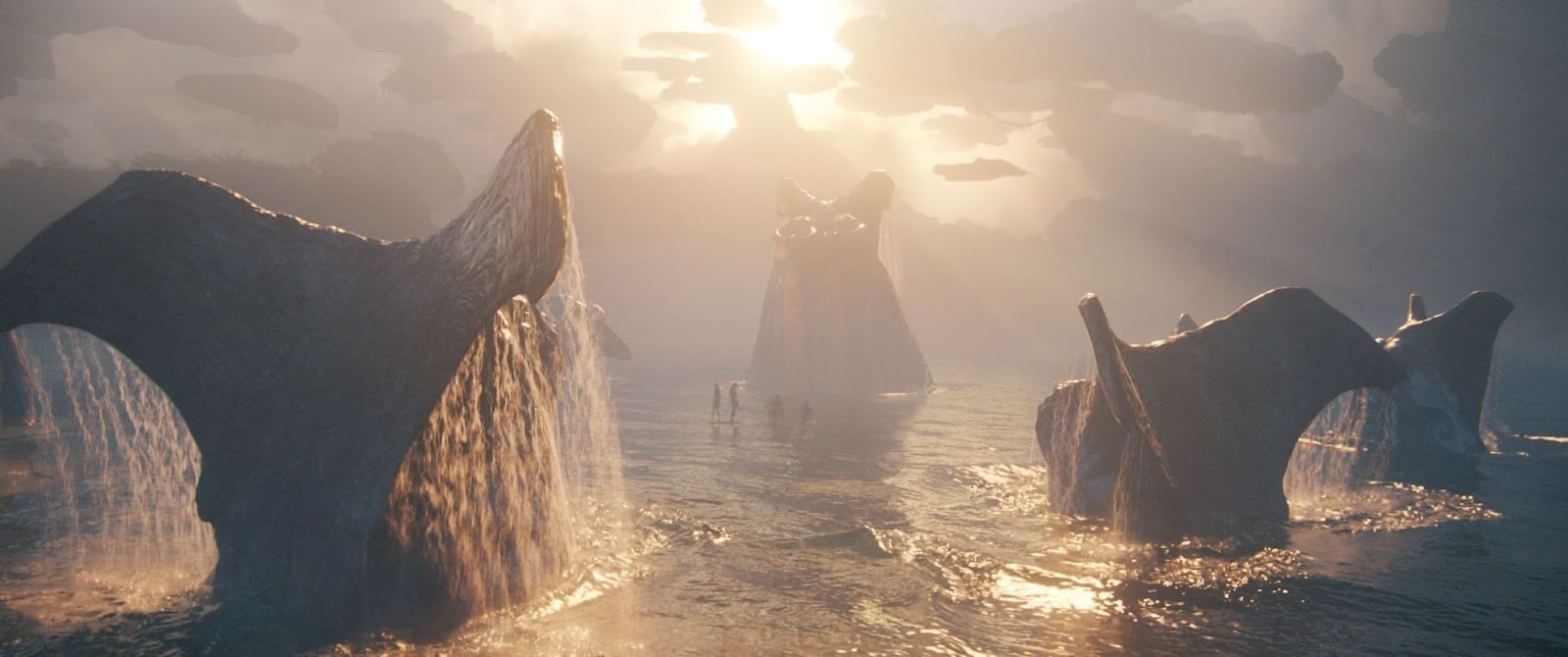
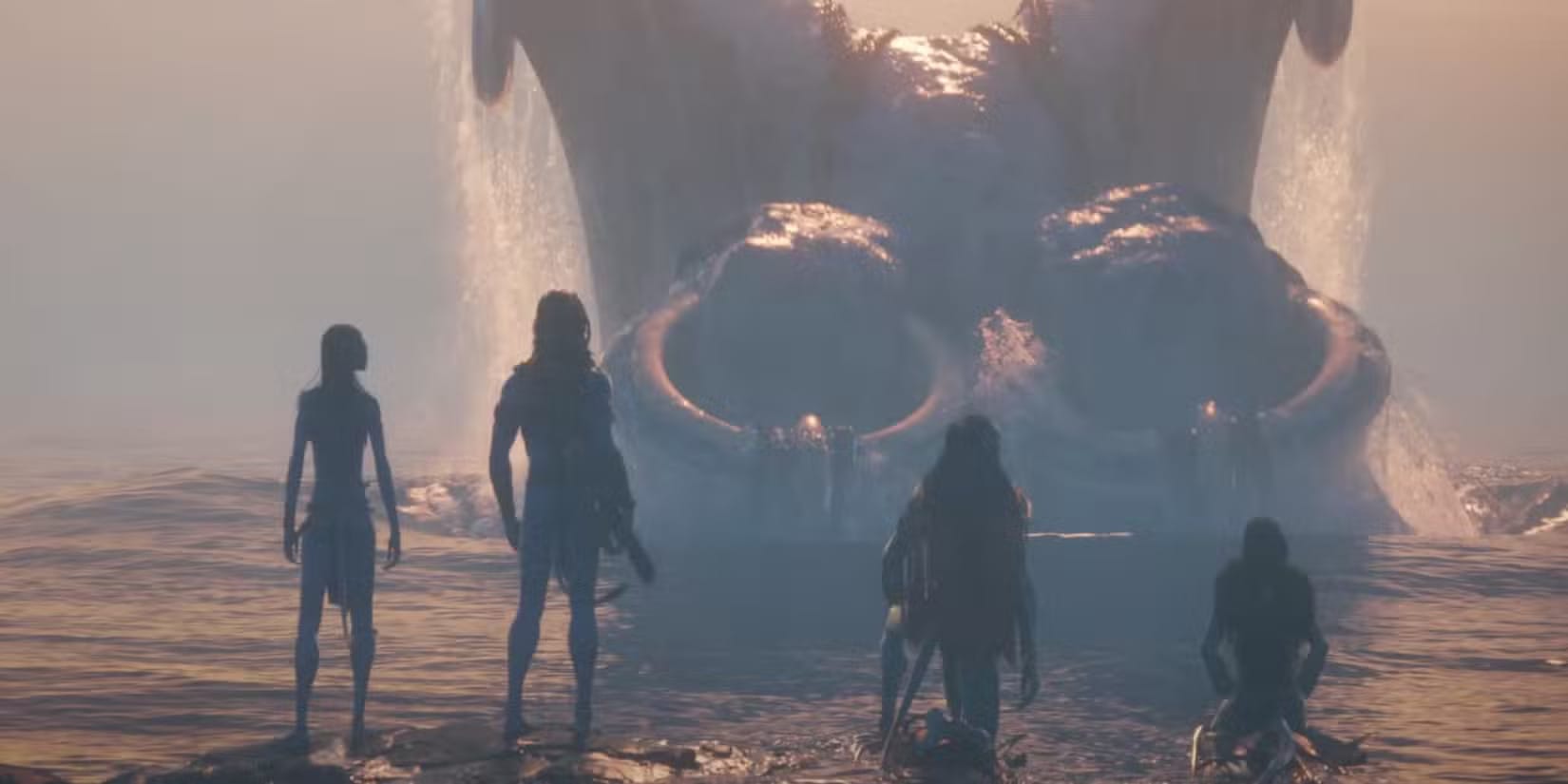
The deliberation before the council is one of the film’s many emotionally stirring moments. Lo’ak and the children of Tonowari and Ronal (Kate Winslet) show up with Payakan and Ta’nok to stand up to the council together and testify on behalf of their friends. The council makes a ruckus as the exiled whale breaches, and the children return their ruckus by promising their own exiles if they are not to be heard.
Two separate sensorial experiences are involved in their testimony—seeing and hearing—and both ultimately point to a greater experience of being acknowledged, feeling like they belong, and being loved. The children want to be heard. For the past three movies, Lo’ak has particularly felt unnoticed and unimportant because no one seems to hear him. Jake always chooses the tactile opinion, right or wrong, instead of coming to the defense of his children; Lo’ak bears the brunt of this in a two-film confrontation with the Metkayina and his father about Payakan, the “rogue bull.” The tulkun council’s decision to hear Lo-ak makes him feel important for the first time. And to feel important is to feel loved.
The other sense important to the scene is sight. “I see you” is also how the Na’vi express their love for each other, including to their tulkun brothers and sisters. Ta’nok’s blindness then manifests something of an existential crisis: the war brought by the sky people threatens their very capacity to love. Ta’nok cannot see others and cannot experience the act of being seen. The war has rendered her invisible, a casualty of both violence and love symbolized by the extermination of her entire clan—the only family she has ever loved. She bears testimony to Lo’ak’s narration that “the fire of hate leaves only the ashes of grief.”
The experience of this stunted love—or, a beautiful creation put into disorder—comes across tonally and through the sum of Fire and Ash. It’s not experienced only by our wounded whale. The film as a whole works this way too. Simplified viewings may lead one wondering about so-called “plot holes” (something no critical viewer ever takes too seriously). The most noticeable of these gaps comes through the character development of Neytiri (Zoe Saldaña), who continues her Na’vi racial supremacy trend she began in Way of Water. Her hate has even begun to drive a wedge into her once indissoluble marriage.
After the goddess Eywa gifts Spider (Jack Champion), the human boy raised by the Sullys, the ability to breathe on Pandora, his presence endangers the entire planet. If humans can replicate Eywa’s gift, they will colonize every inch of the land and every drop of the water. A still mourning and blood thirsty Neytiri wants to kill the young boy to keep their family safe and her husband brushes aside her absurd and murderous idea. When the moment of truth comes, Neytiri changes her mind and, in a moment of radical love, embraces Spider, holds the boy, and tells him, “I see you.” From a chronological character development standpoint, Neytiri’s moral evolution takes place mostly offscreen and internally. There is no direct spur for her progression. Was this internal struggle ever externalized? Did Jake’s piercing points from their last fight rattle in her head? Separated from Spider and her human husband for most of the runtime, how did she “unlearn” her racism? Why did she still look at Spider with coldness when she rescued the two of them just moments before? Or, more simply, why did she change her mind about killing their adopted child?
None of this affects the emotional potential of her development and that’s because even though Neytiri hasn’t been physically present with the camera during certain story developments, her change of heart is tonally and thematically consistent with what viewers witness: Spider saving the Sully sisters during the Mangkwan attack on the Windtraders, the kiss shared by Spider and Kiri (Sigourney Weaver); the human traits of Jake shining through; and, most crucially, Spider’s resignation in the face of Quaritch’s gestures toward parenthood and his determined paternal preference for Jake. Though Neytiri cannot hear the boy cry “dad” in the Abraham and Isaac scene, it is as if she feels the pain of his lament through Eywa.

The metaphor of seeing also extends to Jake’s final proposal to Quaritch to open his eyes. He blinds himself to that which is greater—to the ineffable, to a world bigger than the myopic one of colonization—by keeping his mind closed and his actions and his future imprisoned to the memories he inherited from a dead man. In a way, Quaritch does open his eyes in his last scene, even if he opens them in a dejected, cowardly way.
Cameron and his four fellow co-writers cleverly mirror Jake and Quaritch together, bringing the heroes and villains of conflict close together. Most crucially, both love Spider and, when put in a position to harm the boy, they both make the same choice and spare his life. They each spare his life at the same cost: saving Spider jeopardizes their personal safety. The multi-film lives of Jake and Quaritch echo each other: become a marine, go to Pandora, learn Na’vi ways, fall in love with a hot Na’vi woman, become a father, and make the choice of allegiance (or not). The parallels between the two happen visually too. Jake has an arrow go through his leg; Quaritch has one go through his arm. Jake married a Na’vi woman, and now the colonel finds himself in bed with one. Jake even draws this allusion himself when describing his thirst for blood while riding the great “toruk.” This fine line between heroism and villainy functions not as a condemnation of the series’ protagonist but mostly as commentary on the cyclical nature of violence.
The structure of Fire and Ash is a structure of almost chiastic repetitions. Chiasms are a term borrowed from literary and especially biblical criticism that describes bilateral symmetry revolving around a central axis. One could think of it as a larger rhyme scheme on a plot or thematic level that highlights the point that does not repeat. In the structure A, B, C, D, C, B, A, it is “D” that stands out. (Amusingly, given the film’s climactic scene, it is the Book of Genesis that possesses the most famous chiasms.)
Fire and Ash does not literally structure itself like a prototypical chiasm and instead frequently deploys spirited repetition of plot developments and character responses for dramatic and rhetorical power. For example, while specific elements in the life of Lo’ak, such as the tulkun breaking their pacifist oaths to save him from an attack by other marine life, don’t technically use a chiastic structure, they still intentionally draw attention to themselves through their familiarity and tie together the emotional responses of the first attack and the lonely trauma-bonding with Payakan that follows in Way of Water with the second attack in Fire and Ash, an attack where his new friends have come to help him rather than sending him to perish. This emotional evolution of his relationship with the Metkayina children is stronger because of the parallel structure across the two movies.
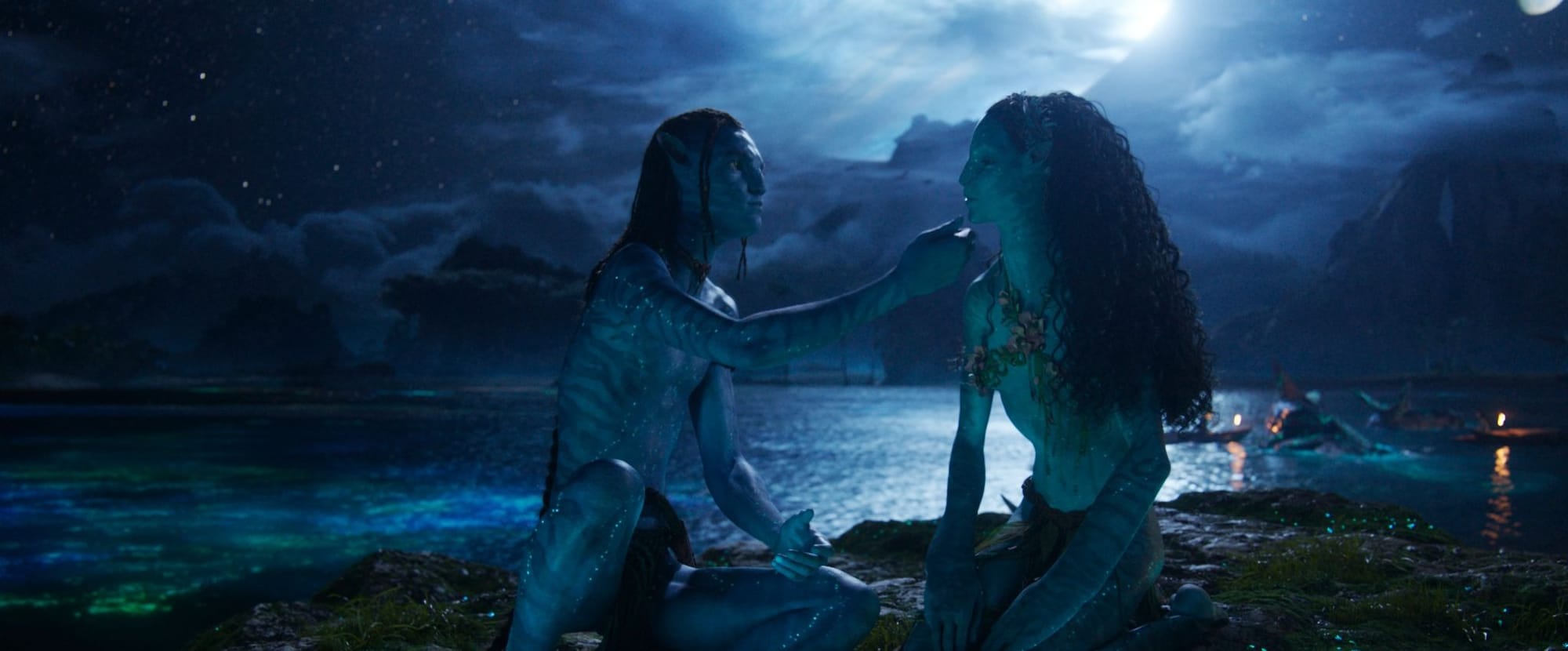
These inter-family and intra-family bonds are the crux of Fire and Ash and the series as a whole. Families constantly expand through natural means, as with the birth of Pril, and through non-natural means like the assumed adoption of Spider or the revelation of Kiri’s strange birth circumstances. (The families also consistently shrink through death.) The Sully family’s assimilation into the Metkayina, and especially Tonowari’s family, similarly expands both families. The expansions of these families coincide with the growth of their circles of compassion: they become better people through their growing families. By contrast, the humans have no family lives. The colonial enterprise has separated the colonizers from their families, something that the dialogue calls attention to at least once and something that helps further erode any potential innocence.
If we look closely, maybe too closely, we can see the auteur within the family dynamics. The strange in-world circumstances of the Sully family, if we allow ourselves the liberty of biographical eisegesis, could come from Cameron’s own complicated and reconstituted family context. His oldest daughter comes from his marriage to Linda Hamilton. He and his current wife, Amis Cameron, brought three more daughters into the world. She also has a son from a previous relationship. Things got more complicated in 2020 when Amis and James filed for permanent legal guardianship over one of their daughters’ friends. The timeline might not add up with the original writing of the Avatar sequels, but it’s not impossible that the fluid family dynamic affected his direction vis-à-vis both Kiri and Spider, neither of whom enters into the family through blood rite.
Jake’s family differs from Cameron’s by having sons. The two living Sully boys, Lo’ak and Spider (via adoption), evince the best and worst of their father. Lo’ak grabs hold of his father’s impulsiveness and rebelliousness, and maybe a little of his romanticism, while Spider inherits his loyalty and responsibleness. Jake is a human in a Na’vi body, so Spider’s absorption into the Sully family visually reminds him, us, and Neytiri most of all of the patriarch’s earthly heritage. He wouldn’t fully make sense as a father or as a person without Spider. A clever auditory match edit of Jake and Spider near the end subtly builds continuity between the two. Jake, traversing a human ship with Lo’ak, confirms things are “clear” before Cameron’s team of five editors (including himself) flashes over to Spider repeating the same word to Kiri. He is his father’s son, the edit affirms.
As with the familial themes, the environmental themes and metaphors present since Avatar crescendo in Fire and Ash with quasi-orgasmic universalism. The kuru—the additional appendage on the back of Na’vi heads that allows them to essentially neuro-link with other life-forms—has always been strangely sexual. When connected to ikran (mountain banshees) or skimwings by kuru, the connector often reacts as if they are experiencing an intense and positive physical stimulation as their appendage ties into the other’s. The source of any discomfort is the quasi-bestial nature of the Na’vi-to-animal aspect of the kuru bonding. This awkwardness is dispelled when Kiri saves Spider by connecting through her kuru to plant life (to Eywa?) and then to the boy. She uses the intermediary of the plant life as a tool to connect to the more important lifeform, Spider, and to give him the ability to breathe Pandora’s air. The perceived lustful intensity of the action intensifies through Sigourney Weaver’s acting with moaning, pain, shuffling around on the ground, and back arching. Hardly anything would have required alteration had she been literally performing a sex scene. It’s more palatable because of the human target of the connection.
Sexual undertones aside, the kuru bonding clarifies the dominant ideology on Pandora where all lifeforms share some primitive and primordial connection. Life flows in a cosmologically Platonic sense from the same source of Eywa. Their goddess also goes by the name “The Great Mother,” relating this universalism back to the familial in a direct way. Biologically, mothers also hold all life before it materializes; mothers are the origin sources in this way. Cameron ties all life together into a shared tapestry of creation in the tradition of St. Francis of Assisi and his language of “Brother Sun … Sister Moon.” This kind of spirituality would be right at home in the diverse civilizations of Pandora.
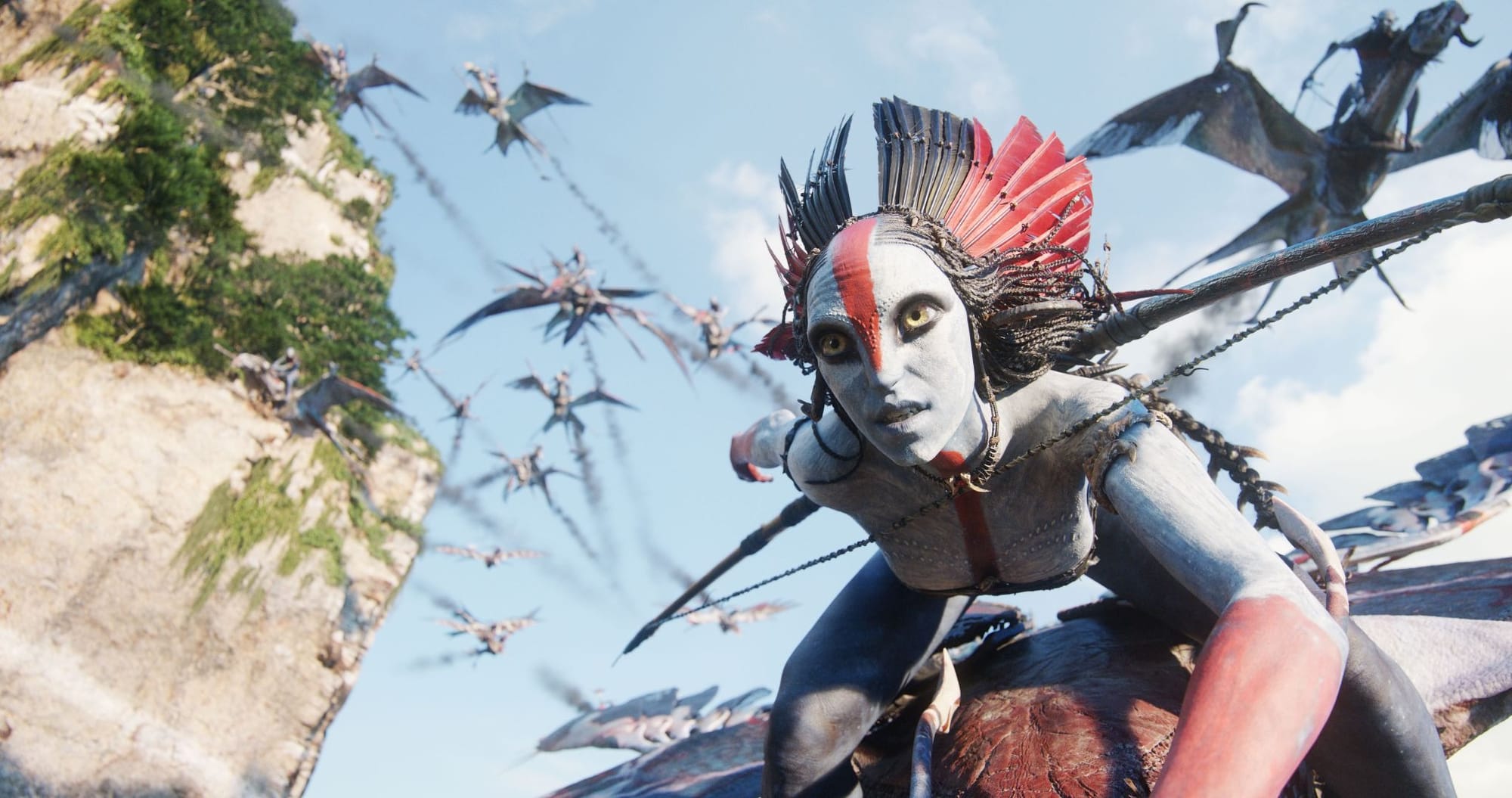
This translates into the action as well. The planet and other lifeforms, mirroring the costs of ongoing conflicts all over our news, pay the price of war. The Mangkwan raid on the Windtraders practically builds around the display of this cost through a succession of non-Na’vi creature deaths; the saddest of these animal deaths is indubitably the burning and cutting of a giant jellyfish-like blimp called a medusoid and an accompanying kreytu’um (windray), whose agonizing death-cry pierces through Simon Franglen’s blasting musical score. The same scene also witnesses two separately hurt or killed ikran: Lo’ak’s banshee and the escape ride that Kiri secures for the Sully children. Varang (Oona Chaplin), the exciting and tantalizing leader of the Mangkwan, even implicitly traces her own personal trauma (and villainhood) through the burning of her family’s home tree—and, to return to the family theme, the death of her mother.
The final battle circles the Spirit Tree. As first shown in the original film, these sacred sites of connection to Eywa and the ancestors create powerful magnetic “flux concentrations.” They stack straight to the heavens like the Tower of Babel. It’s not until Kiri asks the Great Mother for help that the magnetic force becomes relevant to battle by sucking up guns and tearing apart ships. The magnetism endangers the humans and their techno-colonialism while leaving the Na’vi unharmed. Steel weapons “poison the heart,” Ronal testifies earlier. The planet seemed to agree, and the flux concentration is its response. It’s as if Pandora spits the Sky People out.
Russell Carpenter’s unimpeachable cinematography in his second outing in Pandora (Way of Water) also favors the Na’vi and the ways of Pandora over the human and their patterns of colonization. While some viewers will complain simply because it looks different than most films they will ever see, the high frame rate clarifies the world in detail almost as incredible as our own world. All of the underwater scenes utilize the frame rate, as Cameron noted to Letterboxd, making the depths of the ocean otherworldly and sublime. They feel unlike any other underwater scene from a run-of-the-mill film because they are unlike anything you’ve ever seen! The abnormal frame rate endears us to the world of the Metkayina and tulkun, and this verisimilitude intensifies the threat of their destruction. The visual effects spectacle is indelible from the film’s central themes.
The division of the human and Pandora production design work between two designers, Ben Procter and Dylan Cole, respectively, visually divorces the two worlds and the ideologies they embody. Procter’s Bridgehead City is a giant, never-ending grey beast where color has been excommunicated—a pointed contrast with the polychromatic fauna and wildlife of Cole’s Pandora. Like spreading cancer cells, it’s impossible to tell where one grey structure in Bridgehead ends and where the next begins. The grey and blue coldness of the urban cinematography anticipates the city’s extreme racial hegemony. Even segregation isn’t draconian enough for the jarheads in charge: the colonizers refuse to let Quaritch bring his new girlfriend, Varang, into the compound and return his request with a demand for an ethnic purging of the land. All of the time spent in the dystopian futuristic metropolis recenters our gaze on Pandora with a wondrous grace in the same way that a bad year can make a good Christmas more special. The bad things make us more thankful for the good ones.
As a nickname like the “Sky People” would suggest, the indigenous and colonial metaphors aren’t subtle. They’ve also been problematic in complicated ways we can’t fully rehash here. Many of these criticisms, including those from many First Nations and Pacific Islander viewers, look to the past and the myths told by European settlers about the indigenous peoples to construct worlds of inequality and subjugation. While not discarding these complicated responses, we must also make sure to look to the present and the future or we risk trapping indigenous narratives in a metaphorized past when reducing the Pandora-Earth & Na’vi-First Nations metaphors to fetishistic pasts that simplistically track the real-world onto fiction in an A-to-B way. We also risk losing the series’ resonance for the contemporary along the way.
At the heart, Avatar, and especially Fire and Ash, is a rebel’s song. Colonizers are the destructive forces that we know from the real world, and Sully, the American marine in the body of an “avatar,” becomes a symbiote for internal resistance and an invitation to join the great cause of the resistance. Cameron himself has called attention to the indigenous resistance in Gaza, Sudan, and Ukraine more than any other household-name filmmaker while on the press tour for Fire and Ash, even calling it “righteous.” This is where the capstone film in one of Hollywood’s greatest trilogies leaves us. Just as Ronal instructs Kiri in their last interaction, “If there is something you can do, then you must do it.”
Plenty of characters step up to answer that demanding call. Jake’s never far from the action, but it would be impossible to call him the catalyst or white savior of Fire and Ash the same way he was in the 2009 film. Spider defends Tuk and Kiri when Lo’ak disobeys orders during the Windtrader attack; Kiri saves everyone, colonel included, after being kidnapped and hogtied by using her special abilities to command a plant to shoot dart-like materials at their captors; Reya and her brothers save Lo’ak from the squid-like tsyong; several people play a role in busting Jake out of Bridgehead City; and it is Lo’ak’s stubborn persistence, most of all, that helps convince the tulkun council to adapt to the new times of war and rebellion. The resistance this time is awakened from within the indigenous civilizations of Pandora. It just took a blind witness to stir them.
Hopefully, we can find our blind witnesses before it’s too late.