The Arvo Pärt Trilogy
Part of the 2026 Boston Baltic Film Festival

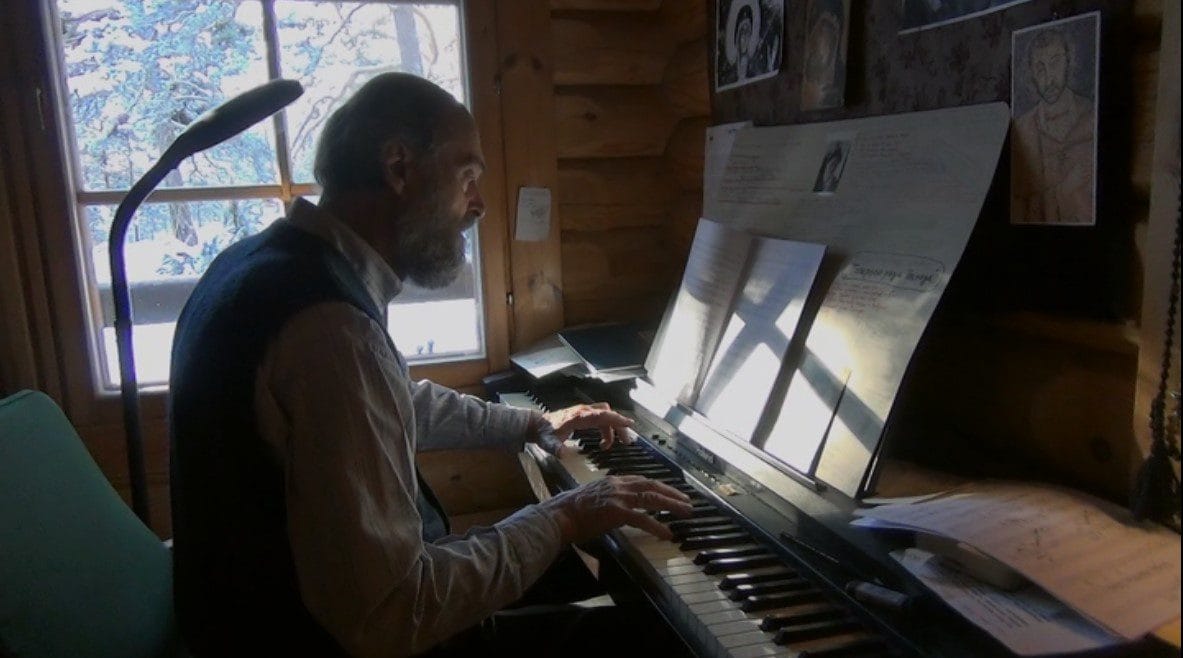
The Boston Baltic Film Festival runs from Friday, 2/27 through Sunday, 3/1 at the Emerson Paramount Center, and through 3/23 virtually. Click here for the schedule and ticket info, and follow along with my multi-outlet coverage at the Boston Hassle and There Were No Gods Left.
Half-way through Arvo Pärt: 24 Preludes for a Fugue, a title card with the words “Perfect Music” introduces the chapter. The world renowned Estonian composer doesn’t play any music in this chapter though. Sitting in a courtyard garden, he listens to the sounds of a slushing waterfall. The chapter ends. This is Arvo Pärt: he isn’t just one of the world’s best composers; as we get to know him through director Dorian Supin’s vantage point, he is also a deeply spiritual soul whose music longs for transcendental permanence. God’s creation sounds perfect to Pärt’s unfoolable ears.
Still moseying around at 90 years of age, the Estonian maestro Arvo Pärt is one of the world’s most important living composers. He was born in 1935 and became a critical composer in the USSR by the early 1960s. In 1968, he penned his prayerful and formally dangerous “Credo” that also prompted an unofficial censorship of his music. He converted to Orthodox Christianity and would spend the majority of the next decade studying Gregorian chant and Renaissance music rather than making new compositions. In 1976, he returned with a two-minute piano score that changed classical composition. The piece, “Für Alina,” evoking Beethoven's “Für Elise,” was Pärt’s first use of his self-named tintinnabuli style, a minimalist technique influenced by Gregorian chant and imitating the sounds of a bell (tintinnabulum is Latin for “little bell”). It’s a deceptively simple minimalistic technique that involves two “voices,” with one chasing the other.
Supin, who recently passed away, directed a trilogy of documentaries about Pärt, his brother-in-law, over a period of roughly 25 years. The first film, And Then Came the Evening and the Morning, was released in 1990 in the last years of the Soviet Union. It’s the shortest and most religious of the trilogy. The musician’s collaborators are mostly Estonian and his fame hasn’t yet spread to the USSR. Supin interlaces his time with Pärt with street interviews asking Estonians if they know who Arvo Pärt is. They do not. The subtext here is arguably subversive: to ask this question presupposes some level of notoriety and fame. And if not in Estonia, or the USSR, then the quiet answer implied over the iron wall. Even in Gorbachev’s thawing Union, this wouldn’t have been a desirable implication for the state. You can get famous in the West.
By the time the 2002 sequel surfaces, 24 Preludes for a Fugue, Pärt was in no short supply of foreigners eager to collaborate. The globalization of his collaborators—and his own speaking of four languages in the film (Estonian, Russian, English, and German)—show how the world has changed since the first, Cold War marked film. He returns to his more-Estonian roots in the 2015 Even If I Lose Everything, which seems to anticipate the death of the still-living nonagenarian. Supin’s style matures by the third film. It’s shot in a more modern widescreen (as compared to the older more square aspect ratio) and more poetic. Rather than using street interviews to create breathing space between scenes, the third film returns to “empty” long shots from above of a long straight street surrounded by trees on both sides. We sit with the street and wonder where it goes just as Pärt’s music shows us: somewhere sublime.
The three documentaries aren’t traditional biographical summaries, even if that comes through in glimpses. Supin doesn’t begin at the beginning, nor does he make a tidy narrative from the evolution in the composer’s sonic style. These three films imitate his philosophical approach to music—minimalist, full of yearning, and introspective—in adapting his life for the screen. Lifting notes from the Baltic poetic documentary tradition (such as in Andres Sööt and Mati Kask’s 1970 short Ice State, which features an original score from Pärt), the Arvo Pärt trilogy obfuscates narrative clarity for slivers of daily life and, in its best moments, evokes stillness and an appreciation for the mundane. He puts bananas in his ears and plays hide and seek with his grandchildren. He also sits in humbled silence as music moves the deepest and most unreachable parts of his soul. That’s what these documentaries are: windows into the mundane life of one of the world’s greatest composers.
The most poetic moment comes in the third film. Pärt describes the feeling a composer gets after certain magical performances. It doesn’t happen always, he trusts, but sometimes, after a truly special performance, the audience will hold their applause “as if to not let in a foreign body” (paraphrased). They need to process the masterpiece before applauding it. The film transitions to an example of this. As Pärt’s music comes to an end, the audience collectively holds their applause for what must be 40 seconds. The musicians left the stage already. The finality of the performance was clear. Supin’s camera sits in this silence, watching the audience from the behind, until they finally erupt in a roaring applause. That wait is pregnant with contemplative potential. The viewer will find it impossible to not turn inward in those 40 seconds, to think of a time we too encountered such a holy beauty in the world.
His music plays an understandably big role in the series. So do the other human senses. One of the preludes in 24 Preludes for a Fugue consists of the composer asking his wife if she grew up eating tomatoes with sugar like he did. She replies, like most sane people, that she only ate tomatoes with salt. Earlier in the same film, at a market, he lamented how it was a shame the camera couldn’t feel the wood of an artifact he picked up. His memories often have physical reminders too, ones he can still touch and reminiscence with. In Even If I Lose Everything, while browsing through old notebooks, he finds a glop of bird shit right on an otherwise blank staff. He labeled it accordingly, even down to the approximate time of the dropping. Holding the physical reminder proudly, Pärt waxes like a pastor about humility and the beauty of the bird shit “music.”
Supin gets cut by the double-edged sword as his brother-in-law. On the one hand, his access (and Pärt’s comfort with him behind the camera, intruding in private moments) are unmatchable. He even breaks the wall and talks to the composer while directing. On the other hand, Pärt, much like the saints who inspired him, is turned into a holy man himself. It’s borderline hagiographical, an authorized biography. Perhaps a small part of why Supin doesn’t go chronological (or even, narratively) through the musician’s life is because it would involve his first marriage, a topic the director’s sister, Pärt’s wife Nora, may be happy to avoid. It’s also possible that Pärt is something of a saint himself. If he is anywhere near as holy as his music, this might be the only rational conclusion.
Still, the recently departed director understands the musician. A scene from And Then Came the Evening and the Morning replicates Pärt’s style in its visuals. An evangelical street preacher, speaking English, proselytizes to any ears lonely enough to listen. The camera sits with him for a while before picking up on the action behind him: a man, with a trash claw, picking up trash while the preacher preaches. The poor excuse of a homily continues as Supin, who also worked as the cinematographer, changes the focus to the quiet and very private man cleaning up his community. Just like Pärt after the magnificence of “Credo,” his brother-in-law puts aside the louder and more attention-drawing religiosity for a quieter, more poetic spiritualism. It’s exactly what Pärt would want.