Political Filmmaking, Ex-Boyfriends, and Gay Propaganda: An Interview with Alise Zariņa on Flesh, Blood, Even a Heart
"No need to hit somebody with an axe."

I’ve seen director Alise Zariņa’s Flesh, Blood, Even a Heart three times now. Often, re-watching films is an experience with diminishing returns, especially in such a short time frame. The film only premiered in November at the Tallinn Black Nights Film Festival. But that hasn’t been the case for my experience with Flesh, and that’s because of Zariņa’s adept, careful, and layered direction. The film gets better with every sitting.
The Latvian director’s second feature film follows Liv (Ieva Segliņa) and husband Marcis (Gatis Maliks) through their mid-life crises. Liv’s father is dying, and she has a lot to process around his death, especially since he wasn’t the best of fathers. Her relationship with Marcis is strained too, and nowhere more than in the bedroom. Does he still find her attractive? How come they don’t fuck anymore? Marcis has problems of his own too. Expectations of gender performance are at the center of his issues. He was a talented dancer in his youth; now he beats up other men with swords for fun.
Flesh, Blood, Even a Heart (Nospiedumi is the Latvian title) is a thematically rich film that takes no shortcuts to provide closure and tidy endings. Life is complex, and so too are the relationships that make it so wonderful in the first place. Emotions arise, simmer, and dissipate at both slight provocations and major life events—and that’s something Zariņa has her thumb on. In a world where simple narratives and social media platforms push black and white dichotomies, stories like this bring back nuance. (Read my full review at the Boston Hassle).
Zariņa graduated from the Baltic Film and Media School at Tallinn University in neighboring Estonia in 2013 and then made her first feature, Nearby (Blakus), in 2019. It’s a Midsummer’s Eve road-trip comedy that won the Latvian National Film Award for best screenwriting. She is also known for her shorts, II Lines and skin-deep, that deal with topics related to gender and sexuality, and a 2024 television show called The Assistant (Asistente) that she made alongside Liene Linde (Black Velvet). In addition to her filmmaking, she is a notable feminist and LGBTQ+ rights activist in Latvia.
I interviewed Zariņa in Boston before the Boston Baltic Film Festival’s screening of her film. Our conversation touched on political and activist filmmaking, what “post-Soviet” actually means, sexism in the film industry, the visuals in Flesh, and why she thinks her films are rather “vanilla,” a label that I disagree with entirely, mostly because I don’t like vanilla and I do really appreciate Flesh, Blood, Even a Heart. Zariņa’s films may not be intentionally inflammatory, but they are never boring, socially stale, or stylistically stagnant.
Alise Zariņa is an exciting and young director with a bright future ahead of her. Cinephiles will do themselves a service by putting her on their radar sooner than later.
The interview has been condensed and edited for clarity.
Joshua Polanski: Gender issues are at the heart of Flesh, Blood, Even a Heart, as well as some of your other works, like II Lines. Do you think as a whole that this is an anomaly in the Lavian film industry or is it becoming more typical?
Alise Zariņa: It’s becoming more typical, but I’m also a bit afraid that we have this tendency to say, “We did it once, so it's done.” The same way we would treat, say, a mafia film: we already have one, [why do we need another]?
There’s a tendency to question how much we actually need to talk about gender and stuff. And honestly, my stuff is very vanilla. I intend it to be fairly vanilla, but I would like to see more. For example, my films are fairly heteronormative, and in Latvian cinema, there is very little discourse about gender or queerness and stuff in those senses. It’s just starting. We’re just touching on those subjects, and I really hope that the perception will not change towards, “Oh my God, we already had one year of feminist films. Let’s go back to the classics.”
JP: What do you mean by vanilla?
AZ: In Latvia, if people know something about me, they would know that I have [certain] opinions. [Laughing.] I try not to copy and paste these opinions into my films.
JP: Are you referring to your activism?
AZ: Yeah. I say things in real life that I would not try to state in a film because I don't see a point in doing it that way. It would scare people away from a film experience if it's becoming this sort of… I don't know… I don't want to say my “propaganda.” That's a horrible word to say. I very consciously try to appeal to a fairly large public.
JP: You don’t want to preach to the choir.
AZ: Exactly. In the future, I want to touch on more subjects that are fairly sensitive. This is just my second picture. That’s also a question of craft and maturity: how do you do that while still being interesting to yourself and without pushing people away?
JP: You said your films are very vanilla, but you started with a film about abortion.
AZ: I did not start with abortion. I started with a beautiful, lovely road movie about a couple working on their relationship. II Lines [a documentary about stories related to women' s experiences with abortion, read by men] was my first short documentary. I’m now working on my first feature documentary—or, let’s be honest, we will start working soon. Documentary is one thing. In fiction, I don’t want to preach. I want to explore more. The two short documentaries I've done have allowed me to explore topics that are important to me.
skin-deep is a bit on gender as well. It’s basically just portrayals of two, at the time, women, talking and exploring their own relationships with their bodies and gender. One of them is now non-binary, so it's weird because I have captured them as a woman. Now the film itself is frozen in time in the wrong way.
These were more in an activist mindset because I wanted it to give voice [to the women], let’s say, though still not preach. I only preached a bit in the TV series, The Assistant, there we preached.
JP: Around gender and sexuality or …?
AZ: Everything. There’s a lot of good [aspects to] the series. But taking responsibility for my own part, it felt that we were too obvious in some places, and Gen Z, who I respect hugely, has been fairly critical of this because they could sense that we tried to push our agenda a bit. If I had more time and could redo it, I would try to be more subtle. It was basically a salad of all the societal subjects we wanted to poke.
JP: Do you think of yourself as a political filmmaker?
AZ: I think of all filmmakers as political filmmakers.
JP: How is Flesh, Blood, Even a Heart political?
AZ: It’s really exploring the concept of us being the first post-Soviet generation. There is also this problem that, for years, we have been called post-Soviet by other countries for way too long, instead of being called by other names and other labels. I think this is my first attempt to change the discourse. What does post-Soviet actually mean? How did it impact us? I mean, [laughing] I can call us post-Soviet, but I'd prefer that other people would not.
Is it very feminist or something? Not really. I don't think so.
JP: Gender is all over it, though. I'm thinking especially of the husband who danced in his youth and plays with swords as an adult.
AZ: It's so funny because we keep hearing two different perspectives on this. It’s an oversimplification, but I’m going to just say an Eastern and a Western [European] perspective. I have heard Eastern people say several times, “What’s her problem? The guy is so cool. The guy’s great. What is she doing?” And then, in France or something, people will say, “Why is he so lame?” I find that funny. When we got the first Generation Alpha reviews, I was also amused because they were immediately on the “he sucks” team, and the 50-year-olds insist, “But he's a great guy!” This comes back to an idea from the Soviet times, which is a phrase your mother would say, “Well, he doesn't drink. He comes home. He doesn't hit you. Why don't you marry him?” It was a very low bar.
I didn't want Marcis to be an asshole. We were exploring this trope, this Latvian masculinity, this passivity of sorts, which is related to the fact that Soviet mothers had all of the workload.
JP: Back to the Soviet Union again…
AZ: Yeah, yeah, yeah. The men were always drinking and made problematic role models for many families. We wanted to, with the actor, explore the challenges of this [kind of masculinity]. He would ask me all the time, “Am I being too much of an idiot right now?” We walked around and asked the women on set, so many times, about this, and they were like, “No, no, you're a very typical guy. You’re just a typical guy. Move on.”
In that sense, of course, I’m looking into the stereotypes. I hope that I’m trying to explain or explore the stereotype instead of presenting them because I have a problem myself with works that are, I don’t know, judging masculinity. I don't think my character is unhappy because he can’t feel masculine enough. It’s more like this parent trauma… It’s a mix of things.
Of course, you can simplify it down to sports and Barbie. In that sense, it’s a very conservative film.
JP: [Joking] You want that on record? It’s a very conservative film. I can lean into that.
AZ: Sure. [Laughing.]
JP: It is about two midlife crises. How biographical or inspired by real life is the film?
AZ: If you take an account like the lifespan for Latvian men, then it’s definitely a midlife crisis.
I took many elements from my friends’ lives. Notably, the relationship with the father figure.
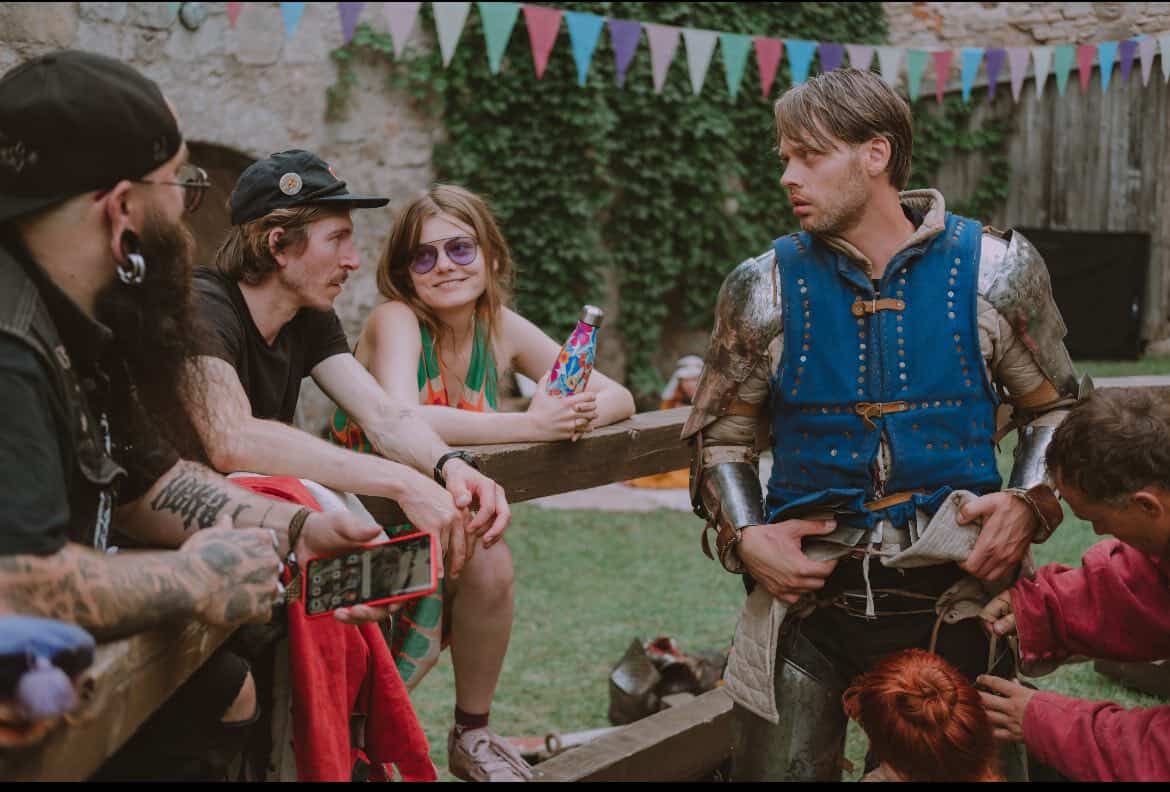
About the [knight-sporting activity], I took that from an ex and used it as a placeholder in the script because I thought I needed some kind of masculine activity. My ex really did that. Not at the time, but he had done it in the past. I thought it was a very visual and fun and weird [way to show this kind of masculinity]. I thought I’d eventually change it because it’s not cool if it’s from somebody’s life, but everything else that came to my mind—learning to play a guitar, for example—was more cliché.
We met the guys who actually do this, we talked with them, and we learned about their community. It’s really small. It's dying. The guy who helped us train the actor was complaining about the youth not being into it. It’s not a very historical [re-enactment]. They're not cosplaying. It’s not LARPing. When you see the fight, that's what they do. They just fight as they did in the old days. They tried to kill each other back then. That’s just what they did. So, it’s not role playing; it is a heavy-duty, let’s attack each other thing. Let’s try to beat the shit out of each other.
I’m not sure if that is a tradition that really needs to be saved. I think it’s okay. It can die. You can keep the beautiful swords on the shelves and show them to each other, but no need to hit somebody with an axe.
JP: You don’t think your film’s going to kickstart the tradition?
AZ: I hope it doesn't insult the guys who do it because they were really nice and helped us, but yeah, I think changing that to LARPing would be better.
JP: Has the ex seen it?
AZ: No. He knows about it. I think he’s mostly worried about the sword thing. I’ve talked with him. When you write a film, you talk to the people who were closest to you. Boyfriend figures are always involved a lot in this filmmaking. They leave an imprint on it. In my thank you section, I always leave all of my ex-boyfriends’ names.
JP: Did you do that for Flesh, Blood, Even A Heart?
AZ: Yeah. There's a thank you line and then my ex-boyfriend’s name. He’s there.
JP: I'm interested in the humor, particularly the Putin joke. It feels like there’s this trend now where, if you’re making a film in the Baltics, people feel a responsibility to touch on Russia and Ukraine. I’m also interested in the writing process of the joke. Where did it come from? How did you come up with it?
AZ: I don't know. I think it just came up. I remember somebody telling me not to put it in the film because it’s a bad thing to even mention this.
JP: Like Voldemort?
AZ: Kind of. Sort of.
It doesn’t show that much, but when we did the fake photoshoot, we used a plastic Lenin figure with the naked ladies at some point. The photos are a small part of the final film. Only in the beginning. But yeah, we made this [Lenin figure].
Also, for example, in the first scene, when you see them playing, there are a lot of posters in Latvian behind them from the independence [period], like the Baltic Way and so on. We wanted to [capture] this feeling about newly gained independence and the confusion that came with it, and then make some references to the modern day, which is a different sort of confusion. The film starts with the newly gained freedom and shows a family living through a turbulent time around this, then you have to almost guard it and make the best out of it. But you’re the first free generation. Are you living a life good enough for that? Your parents didn’t have these choices. You have these choices. Are you using them well enough?
JP: Are you allowed to mess up?
AZ: Yeah, exactly. Of course, the generations before are super jealous of the generation with all the choices, but we were also not so great at adapting to them.
JP: The visuals are warm and personal, but also shaky and handheld at the same time. Can you say a little bit more about the process of coming up with the visuals?
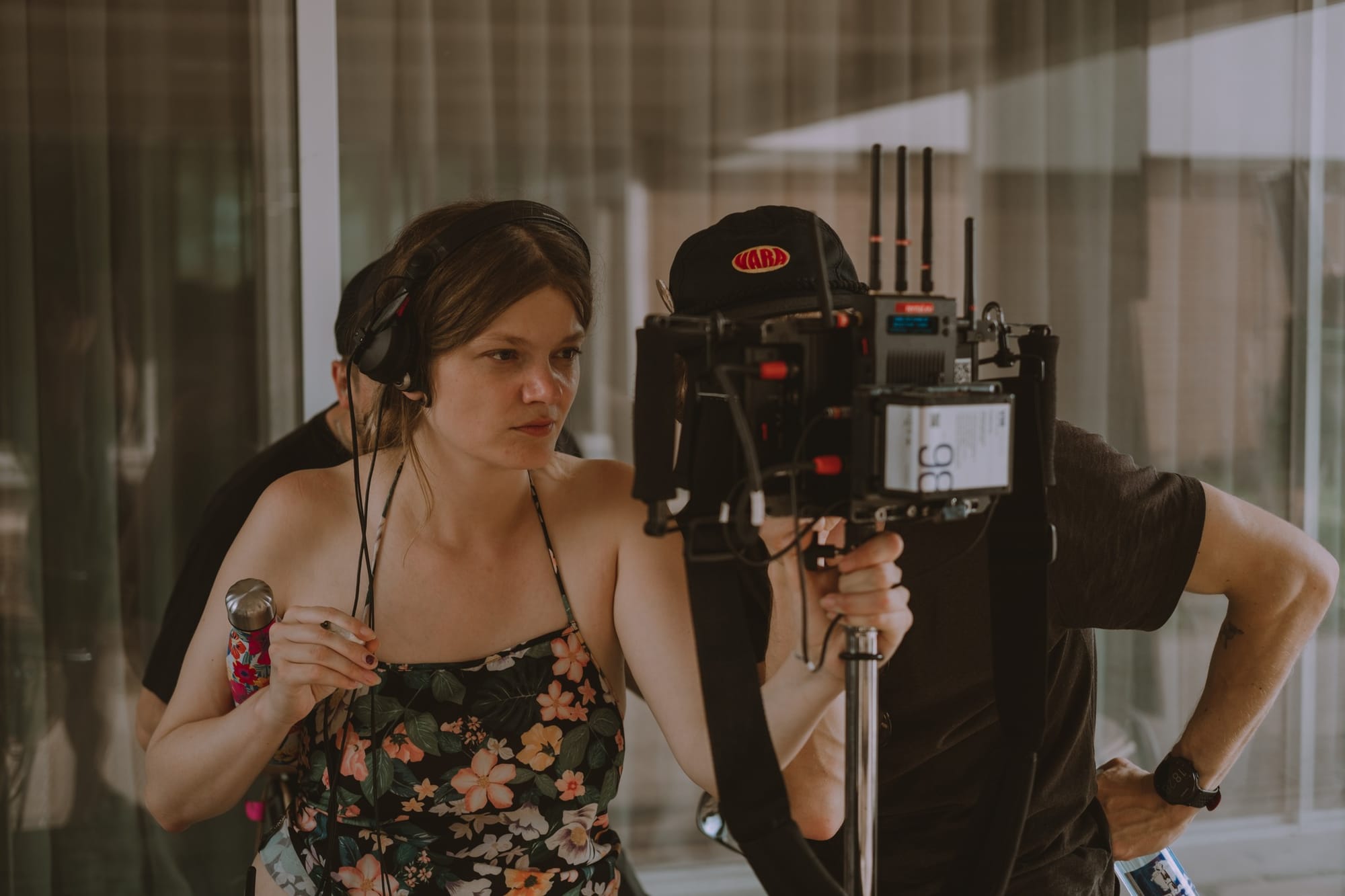
AZ: I thought a woman DOP would be the logical choice. We don’t really have many female DOPs in Latvia though. We really have very few of them—that’s a bit of the sexism in the industry. We decided to work with Mārtiņš Jurevics, and I really respect him. I said I wanted a female gaze, and he told me, “Okay, let’s explore that” instead of “fuck you.”
We had more dreams than we could realize because of the budget, time, and everything. We wanted to make these three worlds—the reality, the memories, and the hospitals—even more different from each other [than we could], but some of our dreams fell through because of the time constrictions and it became more stylistically unified.
My main goals were first, to go close, and second, in the hospitals, to capture this claustrophobic feeling we really have in hospitals. This feeling of being lost. I always got lost in hospitals. It is very typical for Baltics or Eastern Europeans. This hospital system was built in Soviet times. It wasn't built for a human person.
JP: Our healthcare system is shit, which is why I related to the scene where she is talking to the secretary, who tells her she can’t help her and she needs to call this number and someone will talk to her, but that person is also her.
AZ: I collected a lot of stories like this.
I just put on my socials that I'm looking for stories [about the hospital systems]. The number of strangers who will share [is surprising.] These conversations tend to be heavy. And when you end up having a 40-minute conversation with a stranger who is telling you how exactly her husband died in a hospital, you realize this is something that needs to be processed collectively.
JP: Your film challenges binaries, especially around child-parent relations and death. The grieving process isn’t straightforward. Nothing is just straightforward. And the rejection of binaries, in some ways, feels very queer. You’re not limiting yourself to the box. How aware were you of this rejection of binaries? Were you intentionally trying to put on a queer lens?
AZ: I think I have a real problem. At some point, I would like to keep the honesty of a story without losing the story. I'm always afraid to be too nuanced and lose the story altogether.
I don't think I can do much differently. I mean, I'm not really answering your question, I'm just sharing, but I had an interview with a journalist on set and she said, “So this is a movie about forgiving our parents.” I'm like, “No, not really. It's okay to be angry.” And she kept pushing, "But, in the end, you have to forgive." I said, “No, no, no, you don't have to forgive.” She was talking about herself though. She was having her own issues right there. She was processing. That’s something we look for in cinema.
JP: We look for closure.
AZ: We look for closure. It’s tricky. If I were a better script writer, I could figure out the closure that’s still true to the world but with more closure. It’s always a struggle: how open can you live it while still managing to get in the story? I’m not making a classical narrative also because it's hard and I’m shit at that. Honestly, I don't think it’s a choice.
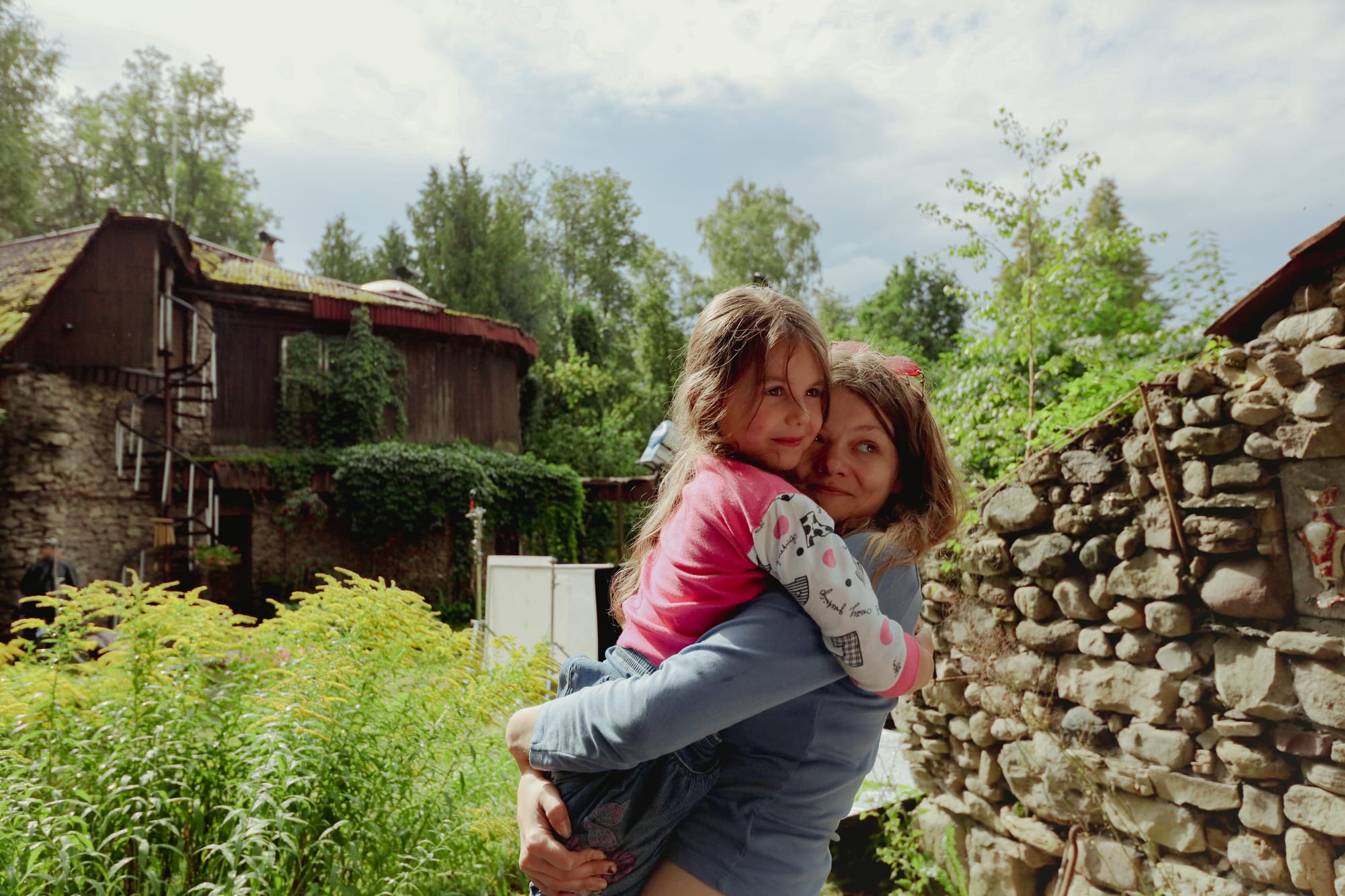
Ieva Segliņa’s father actually died during the making of this film. For her, it became this mix of things. And then it's really hard. Your actress is going through this experience, so you can't just sit down and say, “Well, actually it’s very black and white, and this is how we’re going to do it” because she is herself in a really complicated place. That also gave this weird truthfulness to the film.
AZ: The relationship between Marcis and the boy [he coaches in sword fighting], it was funny because at the beginning we really felt that we had to kill it. There's already this weird sexual thing about the father and the daughter [Liv] going on. At one point, I remember somebody telling me in the rehearsal: “This all looks wrong. This is an underage boy.”
JP: That’s ironic considering the timing of the film with the Epstein files. Maybe it primes people to think that way more.
AZ: Yeah, it was supposed to be another father-figure relationship. It was an interesting side effect, which, at the time, I chose not to explore in any way but to push away.
JP: You are also an activist. You won the 2021 Latvia PEN Award. Can you say a few words about the activism you're involved in? And, I think it is different from political filmmaking, but do you see yourself as an activist filmmaker?
AZ: I see myself as an activist and a filmmaker. Of course, there are some connections.
The last thing I was really involved in was [the protests]. We had some of the biggest protests, a series of protests, in the last 10 years in November because our government decided to try to jump out of the Istanbul Convention, which is the convention against violence targeting women, families, and queer people. I was part of the organization group that [organized the protest]. I wasn't the main person, but I was pretty involved. That’s the last big thing we did. We really thought it was going to be a little feminist protest. We expected to gather like 100 people. But it grew to 10,000 or more for the third protest.
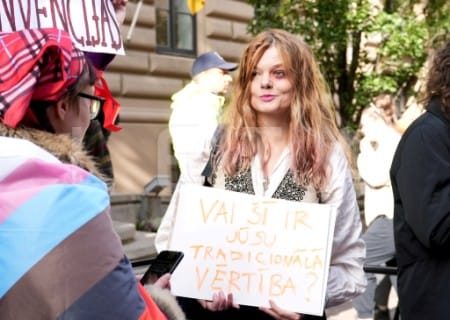
AZ: It was a move to try to shake the government. It felt … too Russian-y to say “no, we don’t need European conventions to protect our women.” Somehow, people really got mad. We got a lot of attention because, in the first protest, I was wearing the national costume and drew a black eye. I was reading a news title about women being killed in Latvia, and the conservatives are usually triggered by the national costume. I think it’s a good time to wear it. Because, for us, it is patriotic.
It was a women's organization and a youth organization, but it grew really big and got a lot of attention. They stopped. They shouted. They didn't leave. And that's the beauty of living in a small country. I’m well aware that in a bigger country [it might have been harder]. In that sense, of course, being a filmmaker helps. Not in the sense that I do [activism] with my films, but I can have some sort of…I don't want to say authority, but… it helps get some kind of attention.
It applies both ways. I’ve read people talk about my films online and say that they will not go and see them because they don’t want that “gay propaganda” that they expect from me. And I'm sorry, I have not yet done gay propaganda. I would love to.