Police Story
[Jackie Chan] is an auteur for the masses, the greatest action star in the history of the silver screen, and arguably our greatest global entertainer.

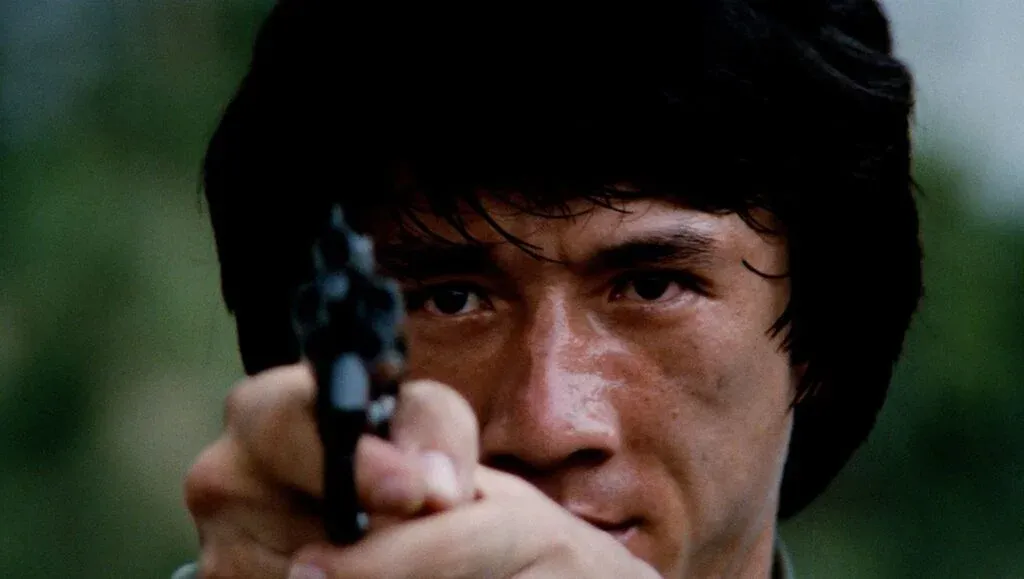
As the economic and political importance of Hong Kong expanded exponentially in the second half of the 20th century, so did the reach of its cinema. And no one embodies this success more than Jackie Chan, the face of Hong Kong cinema exported all around the world. His promise was clear from early on, and the production company Golden Harvest invested accordingly. In 1980, when they let him direct for the first time with The Young Master, his comedic, kinetic, and vulnerable sensibilities synthesized into a recognizable form. Cinema changed. From roughly 1980 to even more roughly 1995, he would go on an incredible run of action-comedies that would enshrine his talents in film history: Wheels on Meals (1984), Police Story 3: Super Cop (1992), Drunken Master II (1995), Rumble in the Bronx (1995), etc. The list doesn’t really end. He is an auteur for the masses, the greatest action star in the history of the silver screen, and arguably our greatest global entertainer. Very few things on this planet bring as much joy as watching Jackie Chan do Jackie Chan things at his prime. And 1985’s Police Story, now 41 years old, is damn close to the summit of that incredible prime.
In the film, Chan plays an obstreperous though honorable city cop named Chan Ka-Kui in the local version and Kevin Chan in international ones. The aftermath of the spectacular shantytown opening — different parts of which are duplicated verbatim in Bad Boys II and Tango & Cash — has Chan babysitting the unwilling witness Salina Fong (Brigitte Lin) as he gets caught up in a storm of crime lords (made possible through the context of Hong Kong capitalism) and corrupt cops (in a system set up by the British and with white men at the tippy top) that’s all worsened by a broken legal system (where the judges and lawyers still don the silly sartorial British white wigs).
The revered Maggie Cheung plays Ka-Kui’s girlfriend, May, who has more to do here than she often gets credit for. Her introduction comes with an understandable flustering at seeing Salina in lingerie and Ka-Kui’s jacket when he comes home late, forgetting his own birthday. The intense theatrical pout she puts on here never really fades from her face as she is always upset with Ka-Kui and his apparent toying with the lines of relational fidelity. Her scenes, though marred by the film’s typically 1980s misogyny, also show her exercising agency and repeatedly deciding to leave Ka-Kui for his misunderstood indiscretions. She doesn’t run back to him in tears: it is he who runs back to her, desperately explaining one thing or another that reflected poorly. The theatricality of both her facial expressions and physicality reflexively draws attention to the camp-like absurdity of the relationship: men are stupid, her performance murmurs with nuance.
Continue reading at In Review Online.