Interview: Romas Zabarauskas on The Activist
“You’re going to get me in trouble!”

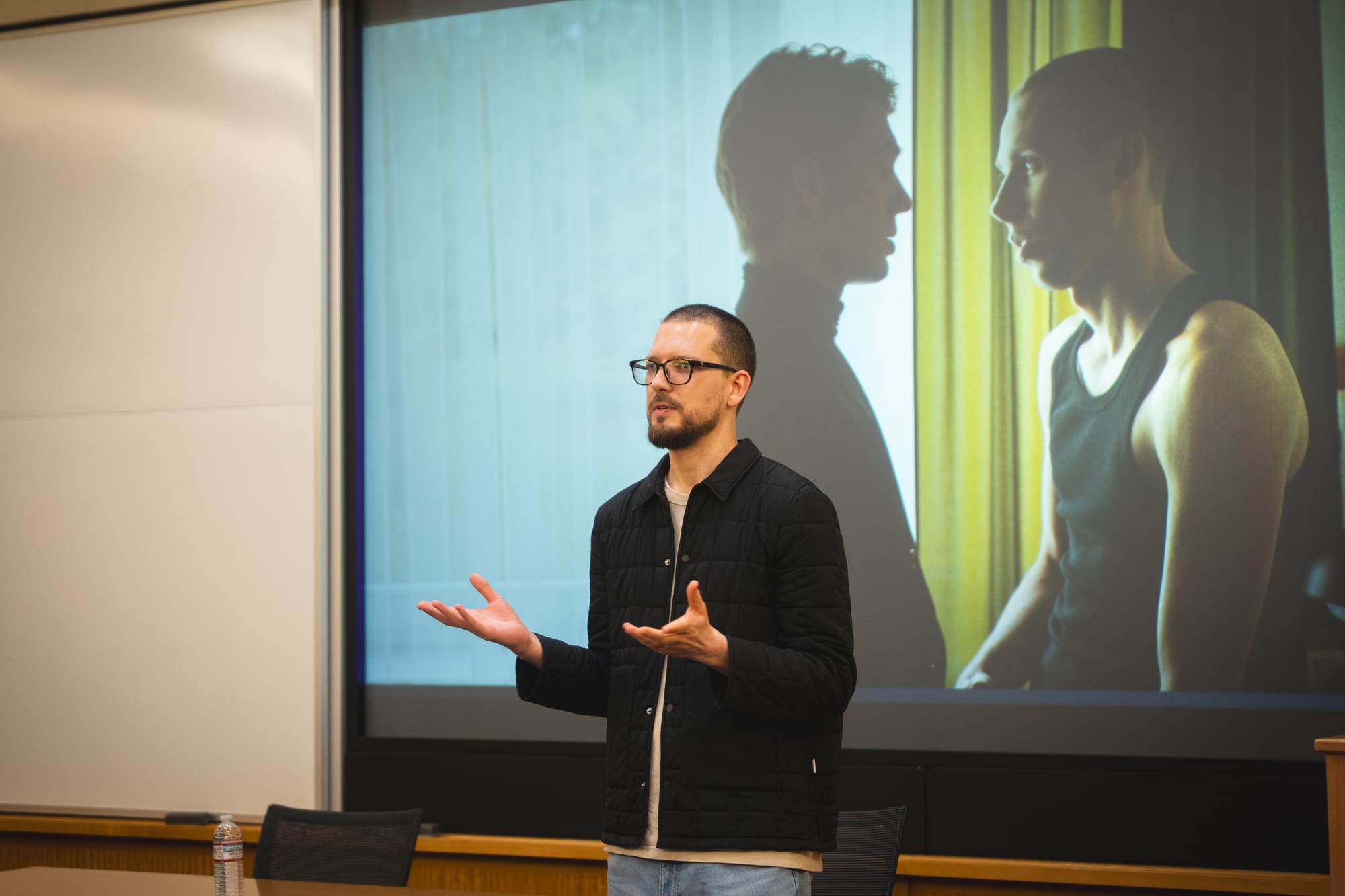
Romas Zabarauskas is the best known queer filmmaker in Lithuania. His debut short film, Porno melodrama, was shown in 2011 at Berlinale and he has been public about his sexuality since then. He followed his debut up with We Will Riot (2013) and then a series of feature films with queer characters at the center: You Can’t Escape Lithuania (2016), The Lawyer (2020), The Writer (2023), and his newest film, The Activist (2025), which just screened at the Davis Center for Russian and Eurasian Studies at Harvard University.
The Activist follows the aftermath of an assassination of a fictional Lithuanian LGBTQ rights activist named Deividas (Elvinas Juodkazis). His boyfriend, Andrius (Robertas Petraitis), a closeted man who didn’t fully understand his partner’s political activism, finds himself enmeshed in the world of a messy queer non-profit named Rainbow Kaunas as they investigate Deividas’s death since the cops won’t. Things get messy for Andrius as he learns more about the broken humans working at Rainbow Kaunas.
In my favorite moment of the film, a trans man, Jonas (played by a real man who happens to be trans, Simas Kuliesius), helps his friend Andrius, a cis-man, learn to navigate masculinity more effectively. It’s an earnest and significant beat in the film that isn’t quite like anything I’ve ever seen before. In a world where trans people are continuously demonized, The Activist paints a more human picture.
I interviewed Romas Zabarauskas prior to his screening over a cup of coffee at Andala Coffee in Cambridge. For over an hour, we discussed queerness in Lithuania, trans masculinity in his film, the film’s visuals, inspiration for Rainbow Kaunas, a Jonas Mekas series he is working on, amongst many more topics.
The interview has been condensed and edited for clarity.
BOSTON HASSLE: How has the reception to The Activist been?
ROMAS ZABARAUSKAS: We released in cinemas in autumn and got almost 12,000 viewers, which is quite good for an art house film.
It is very interesting for me because, obviously, I made the film to be provocative, and it does certainly provoke people across the political spectrum. And in Lithuania, a lot of my friends reported that some people always leave the cinema after the second sex scene. It’s kind of curious because they don’t leave after the first sex scene, which is queer, but also straight at the same time because it’s a trans man and a woman. But the gay scene is too much. At the same time, now that we have started to screen internationally, there are people offended in a sense that we’re critical about the LGBTQ+ representation in the film as well.
BH: Coming from a more liberal perspective?
RZ: Exactly. They think that I went too far, I suppose. It’s difficult to talk about it without spoiling the plot, but we can say that queer characters are both our heroes and our villains in the film. That was kind of the idea. We’re all human and being human is a very flawed experience anyway, so why not?
I also wanted to address the growing far right and current social and political trends from a perspective where I could understand it and see some responsibility on the liberal side too, which contributes to that growth. I don’t think it’s a reactionary idea, but some people are not taking it well. In fact, at the Trieste Film Festival in Italy, one person who was really quite angry said I should be ashamed that I used queer pain for entertainment. And I mean, I’m honestly excited.
BH: Did they know you are gay?
RZ: I shared that information afterwards. But I don’t think that excuses me because I’m still very privileged and I understand that. But it’s kind of funny to see Western urbanite cinephiles lecturing me, as an Eastern European, on how I should represent the queer community better. And it’s okay, actually. It’s difficult to be provocative today because, in a sense, everything is already done. So I’m actually happy that it stirs this debate.
BH: I don’t know how much the Bostonian audience knows about queerness in Lithuania, let alone queer cinema in Lithuania. What is being queer in Lithuania like, and how do you hope to push things a little with this film?
RZ: Or make it worse. [laughs] I’ll share it through my own perspective. I came out in 2011, during the premiere of my debut short soon after its premiere at Berlinale Panorama. In Lithuania, I became famous for being gay in a sense, to be honest, because there were so few people that were out at that time. I was in my early 20s and, for me, it was just natural to share because the film also is connected to queer characters. I didn’t really anticipate or overthink it. All of a sudden, I was going to TV and giving interviews about what it means to be gay in Lithuania and stuff like that. And it certainly branded me as a public activist, which is not something I really desired. In a sense, The Activist is almost a reflection on that too.
I sourced it from my own experiences being close to the activist world, even if I didn’t necessarily want that.
What’s changed since then is definitely that there are a lot more LGBT people that are out now, and I’m happy that I contributed to that with my own films and my story. Coming out wouldn’t make such a media stir at all [today]. Even myself, I feel more accepted already as a filmmaker. Of course, my career continued to grow also, but also just that there is a little bit less pressure now that there are more people that are open.
In terms of society and equality, step by step [Lithuania] is becoming more open, more accepting, and that part of society that is already more open [and accepting] has become more vocal in their support. These are positive changes.
Continue reading at the Boston Hassle.