Fritz on Fridays: The Science-Fiction Films of Fritz Lang with Ayesha Khan
"Metropolis not only brought this to life for the moving pictures, it also stretched the idea of what cinema is about and capable of."

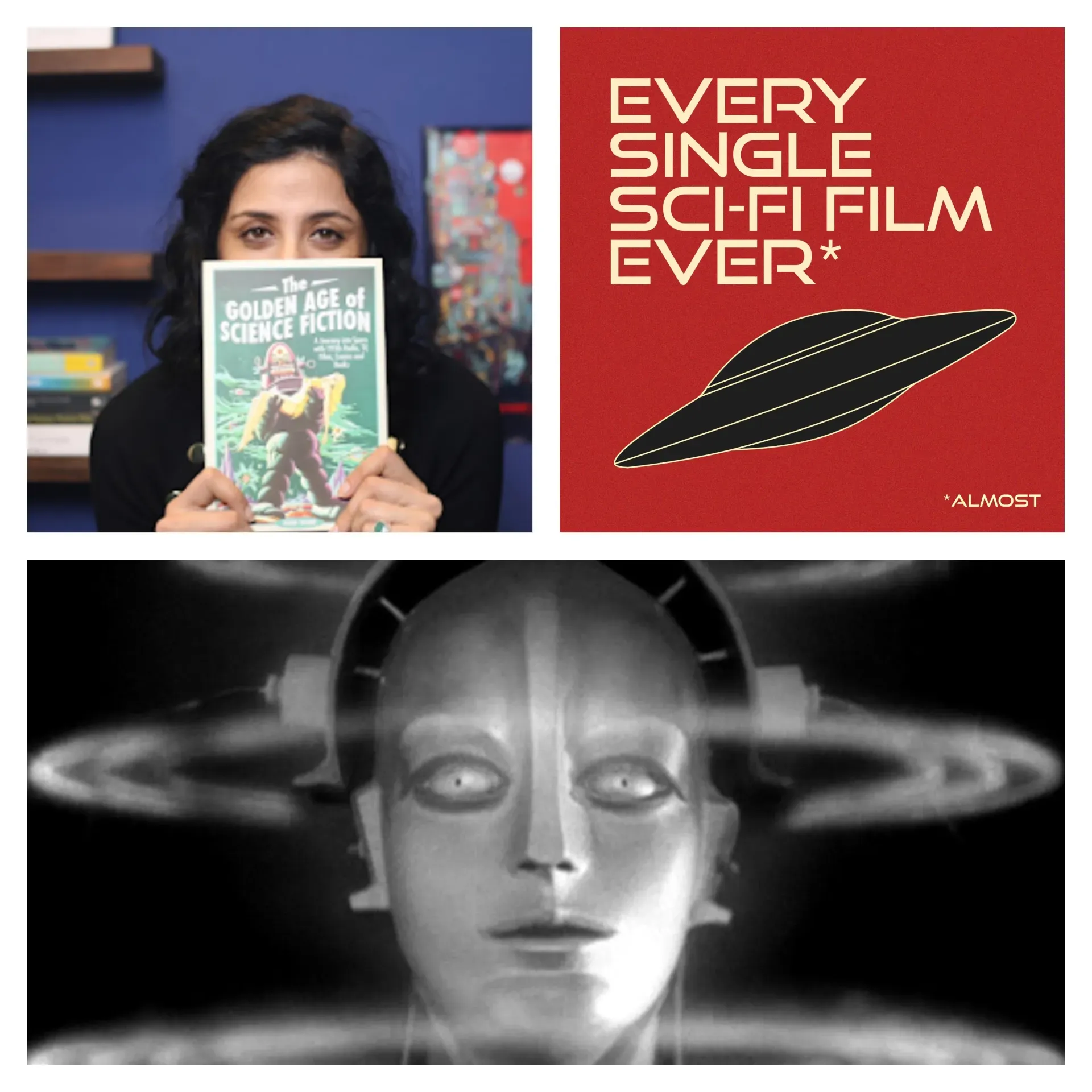
On the first Friday of every month, this column by critic Joshua Polanski will feature a short review or essay on a film directed by Fritz Lang (1890-1976), the great Austrian “Master of Darkness.” Occasionally (but not too occasionally), Fritz on Fridays will also feature interviews and conversations with relevant critics, scholars and filmmakers about Lang’s influence and filmography.
Fritz Lang, rightly or wrongly, is best known for his work in film noir. He was nicknamed the “Master of Darkness” for a reason: He is one of the genre’s patriarchs. But it wasn’t Lang’s only genre. He made adventure films, mythical epics, Westerns, war films and even romances (depending on how flexible one wants to be with the term). But arguably the most well-known Lang film, Metropolis, is none of these.
Though he only ventured into science-fiction twice — first with Metropolis in 1927 and two years later with Woman in the Moon in 1929 — his mark on the genre is as fixed a feature as the sun on the horizon. His gigantic sci-fi spectacle is turning 99 this year, and its mark on pop culture is still felt from George Lucas’s C-3PO to David Bowie’s Diamond Dogs.
In Metropolis, Freder Fredersen (Gustav Fröhlich) is a nepo-baby with main character syndrome. His father, Joh (Alfred Abel), runs the appropriately named Metropolis. The city never sleeps, and that’s because it never runs out of its worker-slave supply. While enjoying bourgeois leisure activities in a pleasure garden atop the city, a pretty young woman from Worker’s City catches Freder’s eye, and he pursues her and follows her back down into the industrial hell beneath. The woman’s name is Maria (Brigitte Helm), instantly reminding viewers of the biblical Mary. She becomes a prophet to the workers, promising them a better life with the delivery of a salvific “mediator.” Rotwang (Rudolf Klein-Rogge), an evil scientist employed by Joh, creates an evil, false mechanical Maria that has more violent ambitions.
The much lesser-known Woman in the Moon is simultaneously romantic and misanthropic. Professor Georg Mannfeldt (Klaus Pohl) is a cutting-edge astrophysicist whose theories of space travel and (especially) the moon being gold-rich make him a laughing stock in high-class society. A much younger Wolf Helius (Willy Fritsch) gets a whiff of the professor’s treatise and solicits his help to go to the moon and get rich. Their journey is privately funded, a bit of an anomaly this early in the genre.
To discuss Fritz Lang as a science-fiction filmmaker, I had the pleasure of talking to Ayesha Khan, the always smart and entertaining host of the podcast Every Single Sci-Fi Film Ever.
Khan, a passionate and knowledgeable lifelong student of science-fiction, brings on relevant guests for each episode to discuss the most important films in the genre, starting from 1902 and working to the present. For the episode on Metropolis, she invited Michigan State University’s Sonja Fritzsche, a professor of German Studies and editor of The Liverpool Companion to World Science Fiction Film, and Noah Isenberg, a film historian with a focus on the Weimar era, to guide listeners through the film’s context, themes and influence.
Every Single Sci-Fi Film Ever won the 2025 Ear Worthy Award for Best Movie Podcast.
Our conversation was free-flowing and spontaneous as we discussed our preferences between the two films, the ethical quandaries of watching Lang, their respective influences and much more.
The following interview has been condensed and edited for clarity.
Joshua Polanski: I believe you’re pretty tepid on Woman in the Moon and I presume that’s not just because of its stupid title with the faulty preposition?
Ayesha Khan: I hadn’t actually seen any Fritz Lang films until I started this podcast, other than The Big Heat. I’d heard of Metropolis. I had a magazine and got this free Metropolis disc from it. I’ve had it for maybe two decades and I hadn’t seen it.
JP: Wow.
AK: Yeah. And I knew I had to watch it. It’s one of those films you have to watch. It felt like eating my greens. “I’ll get to it. I’ll get to it.”
Then, I didn’t have a DVD player for the last 10 years or so, and so, I just never got to it. When I did the podcast, I watched Metropolis and then Woman in the Moon and M all together in a row. In Woman in the Moon, [while] you can see little hints of the direction Fritz Lang would go, it feels more … interpersonal; I can’t call it noir, but [you get hints of] that kind of city interaction Lang would then later go on to do.
Whereas I think Metropolis is such a fantastical spectacle from the first scene, as soon as the cityscape comes up and Metropolis is across the front, it’s such a powerful image and that continues. It just blew my mind because obviously this is one of the last silent films, and it feels like such a way to go out. Sound is about to be introduced in the same year. It feels like such a beautiful visual delight of a film.
And then you have Woman in the Moon, which is entertaining enough. It’s kind of enjoyable but it doesn’t blow your mind, in my opinion. It is a nice film where they have a really long rocket sequence. It’s kind of sweet. And then M is absolutely phenomenal. From those three, Woman just kind of sits far below.
JP: That’s fascinating. I think I have the exact opposite opinion. I would put Woman in the Moon at the top of those. Metropolis isn’t too far behind, but every time I watch Metropolis, the ending with the whole mediation stuff bothers me a bit more. I like the ending of Woman a little bit more every time I watch it. So gradually, those two swapped places.
AK: Oh, interesting.
JP: And then the launch sequence in Woman in the Moon is just perfect. I love that scene.
AK: That’s really interesting. Can I ask you a question?
JP: Yes, of course. Go ahead.
Continue reading at the Midwest Film Journal.