Avatar: Fire and Ash
The incredible capstone to one of the finest sagas in blockbuster history.
“I see you.”
This is how the characters of Pandora express love for one another. The Sully family says it more than most families. They are the sort of tight-knit family unit forged through wars, exile, and loss. They beautifully express their love through a metaphor for sight and it is not just beautiful because of the warm tenderness the verb manifests. Sight is also one of the things that makes us most human, or most creaturely. The unalive will never be able to see, to hear, or to feel. And James Cameron reminds us of this in a video introduction that plays before Avatar: Fire and Ash, where he goes out of his way to declare the film free from generative AI images. It’s straight from the hands and digital pens of artists. Real, human ones. Just as Pope Leo XIV said, AI “won’t stand in authentic wonder before the beauty of God’s creation.” Cameron makes wondrous cinema.
The third film in the Toruk Makto trilogy, Fire and Ash, testifies to our very best—and very worst—human selves. It is also the incredible capstone to one of the finest sagas in blockbuster history.
As the Sully family mourns their son and brother Neteyam with their new reef-family in the Metkayina clan, an aggressive group of anti-Eywa pyromaniac Na’vi called the Mangkwan joins forces with the Sky People in a joint quest for domination and exploitation. The film’s marketing misdirects somewhat, though: this isn’t a journey to a new land and a new clan like the last two with their forest and water settings. The epic conclusion stitches together the settings that come before it—land, sea, and sky—while grounding with the Metkayina as a direct continuation of The Way of Water. The two were originally one story anyhow.
Much like a great painting, the visuals of the Avatar films first pull us in. And the visuals here, especially in the choice format of 3D IMAX with high frame rate, are undisputedly extraordinary. The 400 million dollar budget easily looks double the colossal cost. Filmed by Russell Carpenter, who also shot The Way of Water back-to-back (but not the first film), the action-tight trilogy climax ventures into higher intensity and explosiveness compared to its predecessor and its interrupted peaceful utopia. After the death of Neteyam, there is no respite for Jake Sully (Sam Worthington) and Neytiri (Zoe Saldaña). War is already here, Colonel Miles Quaritch (Stephen Lang) is still in pursuit of Sully, and the Sky People are coming for the tulkun. The images sing with violent action. It’s the closest Cameron has ever gotten to a pure thrill ride. The triple-surfaced war—on land, sea, and water—brings the best out of the 3D format, a presentation that benefits mightily from a complexity of depth. It’s a modern, digital twist on the tableau vivant populated with up to three different Na'vi ethnicities, talking whales & flying dragons, other alien lifeforms, and human colonists.

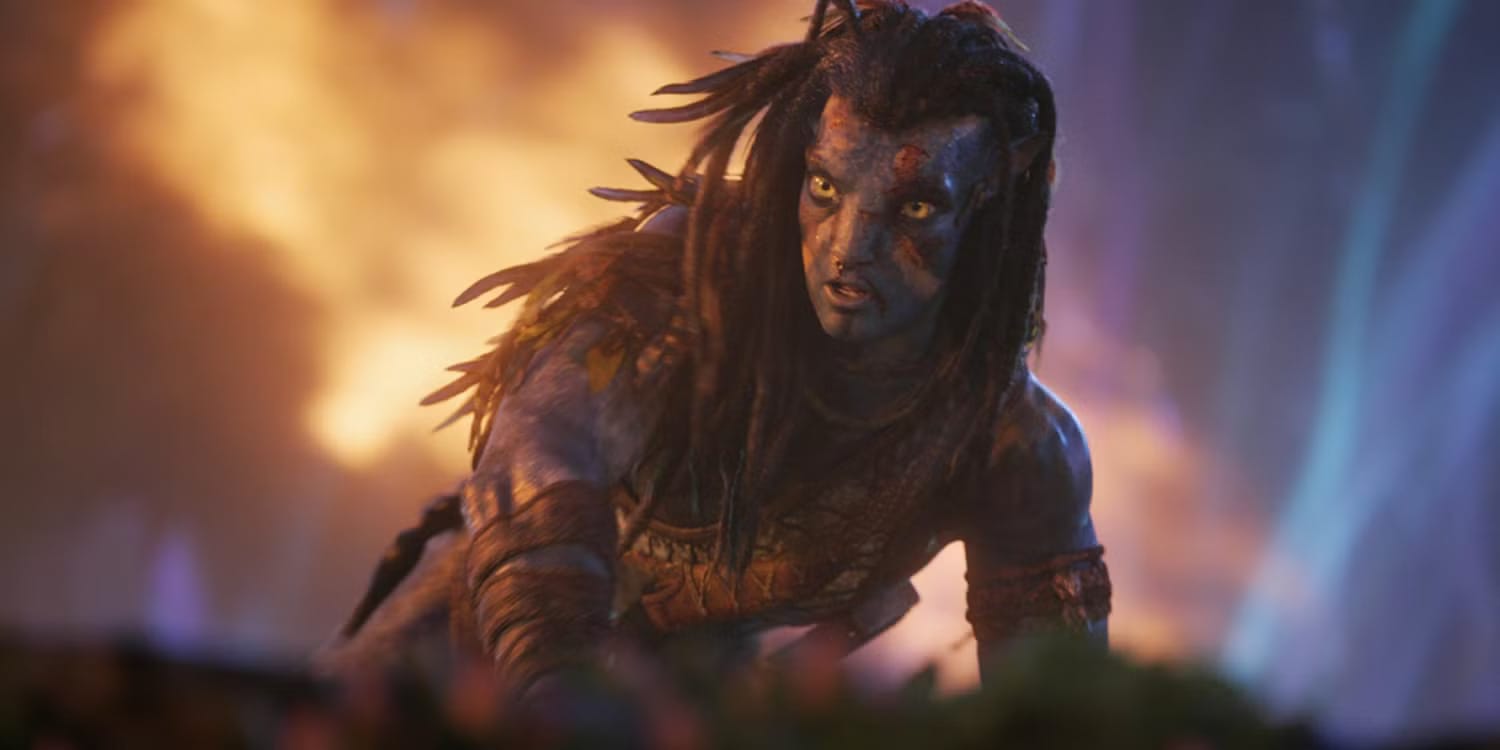
It’s also the most morose Avatar yet. Varang, the leader of the Mangkwan or Ash tribe who dons a red-feather warbonnet, is a big part of this. Played by a tantalizing Oona Chaplin, the granddaughter of Charlie Chaplin, she has power simply because she assumes it. Her people follow her blindly and without question. An alluring and masochistic sexual tension effuses between her and Quaritch, tying together their quest for power with bedroom domination. The red of the Mangkwan and the blue of the Metkayina violently clash into one another.
More time is also spent in the human settlement, Bridgehead City, than in previous films. It’s a giant grey beast where color has been excommunicated. The city never seems to end, and the only emotions one can experience here are negative: joy, love, and even desire can only be felt outside the walls. The military food chain quickly shuts down Quaritch’s fetishistic dreams of seducing Varang after they arrive together. It’s a city of extreme enough racial hegemony that even segregation won’t do. Like spreading cancer cells, it’s impossible to tell where one grey structure in Bridgehead ends from where the next begins. Bridgehead City might as well call itself Babylon.
Speaking of the Bible, the film’s darkest moment—a scene beat-for-beat straight from the Book of Genesis and involving Jake and Spider (Jack Champion)—is also its most touching. The operatic scale of the quasi-biblical scene gets intensified by the moment the two characters have alone, almost like the exaggeration of a duet in a theatrical performance. It’s one of the three times I have cried in the theater this year. Pay attention to the lines of vision between Jake and Spider in the scene: the drama of their eyelines tells the entire story on its own. The dialogue merely reiterates what the eyes have already spoken. It is genius filmmaking reminiscent of the late silent and early sound geniuses like Fritz Lang, whose orange and shadowy black tinting and draconic beast in Die Nibelungen almost certainly inspired several solar visuals in Fire and Ash.
Fire and Ash is the first time we have seen inter-species conflict on Pandora. In part because of the divided-house war, Cameron steps further and even more complicatedly into the world of indigenity. Varang’s warbonnet will instantly recall the headdresses from various Indigenous peoples of the Great Plains—a creative decision that puts the Navi dangerously close to “playing Indian.” Oona Chaplin, it is worth mentioning, has more than Charlie’s blood running through her veins: she is Mapuche, the indigenous inhabitants of Chile and Argentina — a fact that complicates the costume choice but by no means morally vindicates it. The scalping bit then brings Pandora full circle into the western genre and its violent fetishization of the First Nations. This doesn’t fully escape Cameroon either, though the whole white savior “going Indian” has. The parallel is essential to the moral conclusions Avatar draws about the colonists. In this fantasy, the heroes accomplish heroics as they repel colonization and ethnic cleansing.